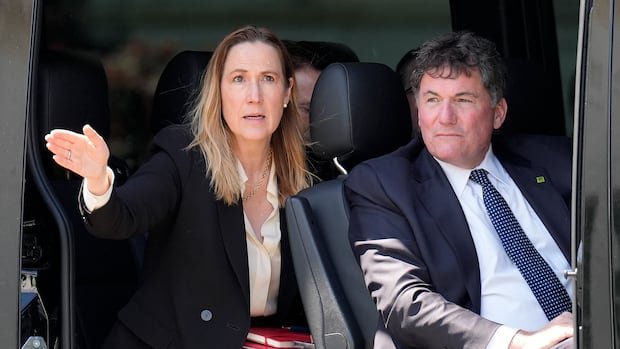

High-level trade discussions are ongoing this week in Washington, D.C., between Canadian and U.S. officials, with Canada aiming to resolve specific economic issues affecting trade between the two nations. Dominic LeBlanc, the Minister of Canada-U.S. Trade, along with Privy Council Clerk Michael Sabia and other officials, are concentrating on reaching agreements in the steel, aluminum, and energy sectors in the immediate term.
According to Jean-Sebastien Comeau, LeBlanc’s spokesperson, Minister LeBlanc is engaging with senior U.S. officials in Washington, D.C., as part of Canada’s efforts to reach a deal with the United States. Following Prime Minister Mark Carney’s recent visit to Washington, LeBlanc highlighted the positive and substantive discussions on trade matters with U.S. officials.
Meanwhile, pressure is mounting in Canada, with some provincial leaders and mayors urging Prime Minister Carney to take a firmer stance against U.S. President Donald Trump amidst the ongoing discussions.
During last week’s discussions, LeBlanc mentioned that President Trump instructed U.S. Commerce Secretary Howard Lutnick and Trade Representative Jamieson Greer to continue negotiations with their Canadian counterparts to finalize agreements in the aluminum, steel, and energy sectors. The aim is to swiftly reach agreements that benefit both countries in these critical sectors.
If agreements can be swiftly reached, LeBlanc anticipates that talks between the two nations could progress to address other sectors as well.
Impacts of Trade Disputes
In a bid to incentivize automakers to relocate operations to the U.S., President Trump imposed 25% tariffs on cars and light-duty trucks, excluding the portion made from U.S. components. Stellantis recently announced a $13 billion investment over four years to expand manufacturing capacity, generating over 5,000 jobs in various U.S. states.
As part of this move, the production of the Jeep Compass, initially planned for the Brampton Assembly Plant, will shift to the Belvidere Assembly Plant in Illinois, although Stellantis asserts that it still has plans for the Brampton facility. This decision has sparked discontent from federal and Ontario authorities, given the previous agreements with Stellantis-LG Energy Solutions, which included incentives for battery production and a commitment to maintain operations in Brampton.
Expressing disappointment with the decision, Industry Minister Mélanie Joly emphasized the necessity for Stellantis to uphold its commitments regarding the Brampton facility. Prime Minister Carney pledged to collaborate with Stellantis to create new opportunities in and around Brampton, emphasizing the importance of fulfilling promises made to workers.
President Trump acknowledged that Stellantis’ actions were linked to his tariff policies, aligning with his vision for bolstering American economic dominance. Ontario Premier Doug Ford emphasized Stellantis’ obligation to honor its commitments to workers in the region.
Provincial Leaders Advocate for Lumber Industry
In a recent development, the U.S. levied an additional 10% tariff on Canadian lumber on top of the existing 35% tariff, along with a 25% tariff on Canadian wood products like furniture. Although Prime Minister Carney pledged $1.2 billion in support for the softwood lumber industry, the assistance is yet to materialize.
B.C. Forestry Minister Ravi Parmar emphasized the urgency of receiving the promised support to safeguard the Canadian forest sector. There is a provision for up to $700 million in loan guarantees for forestry firms and $500 million in grants and contributions to drive product development and facilitate retraining of lumber workers.
Provincial leaders like Minister Parmar and New Brunswick Premier Susan Holt have urged Prime Minister Carney to prioritize resolving the softwood lumber tariffs. In response, Industry Minister Joly indicated that support measures for the lumber industry would be unveiled imminently, focusing on operational assistance and capital expenditure funding for companies grappling with unjustifiable tariffs.