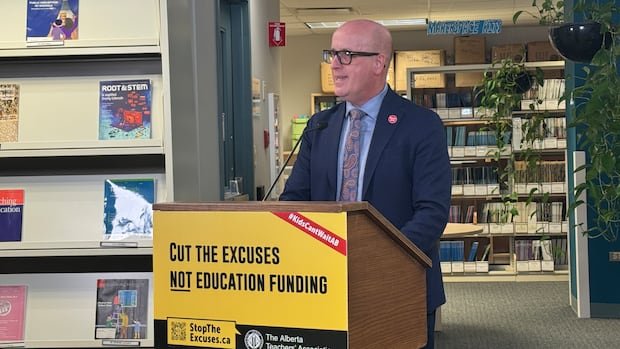

The president of the Alberta Teachers’ Association is advocating for the Alberta government to allocate funding to meet class size recommendations set in 2003 post the significant teachers’ strike. According to ATA president Jason Schilling, the province’s public, Catholic, and francophone school divisions would require over 5,000 additional teachers to achieve the prescribed pupil-teacher ratios outlined in that report.
During an appearance on Alberta at Noon, Schilling mentioned that the government’s stance on these numbers does not align with their interests. His remarks come amidst the impending strike where 51,000 teachers are expected to participate starting Monday.
Schilling and Finance Minister Nate Horner stated separately on Alberta at Noon that further discussions between the teachers’ association and employers are unlikely before Monday. Horner clarified that there are no immediate plans to reconvene the legislature ahead of schedule to enforce back-to-work legislation on educators.
In response to concerns about growing class sizes, the Alberta Commission on Learning was established following a 2002 strike involving 22,000 teachers across 22 school divisions. The commission’s recommendations included reducing class sizes and allocating additional education funding to address school pressures. It proposed average class sizes of 17 children for kindergarten-to-grade 3, 23 children for Grade 4-6, 25 students for junior high, and 27 students for high school classes.
The impact of class size on educational outcomes is extensively researched, with a 22-year-old report emphasizing the academic benefits of smaller class sizes, particularly for disadvantaged students. Despite this, the Alberta government ceased tracking class sizes in 2019. Data from Edmonton Public Schools and anecdotal evidence suggest that many classes now exceed the recommended sizes.
Between 2020 and 2024, Alberta’s student population grew by 91,000, amounting to a 12% increase, with 825,817 students enrolled last school year. If the teachers go on strike, approximately 730,000 students could face class cancellations.
The ACOL report highlighted the importance of considering individual student needs when determining class sizes and called for government funding to support achieving the recommended class size targets.
Class size, teacher pay increases, and the growing proportion of students with additional needs are key issues in the ongoing contract dispute. Despite a recent rejected deal that included commitments for new teaching and educational assistant positions, negotiations remain deadlocked.
Finance Minister Horner acknowledged that teachers have the right to strike and mentioned the possibility of forcing them back to work, though he emphasized the need to avoid causing long-term educational harm to students. The Alberta legislature is slated to reconvene on October 23, with hopes that a resolution can be reached before that date.
Premier Danielle Smith ruled out class size caps due to insufficient school infrastructure. The government is investing $8.6 billion over seven years in the School Construction Accelerator Program to address this infrastructure gap. Additionally, the province recently allocated $300 million over three years to create more educational assistant positions.
Teachers have voiced the need for wage increases to keep pace with the cost of living and improve learning conditions for students, emphasizing the urgency for a resolution to the ongoing dispute.