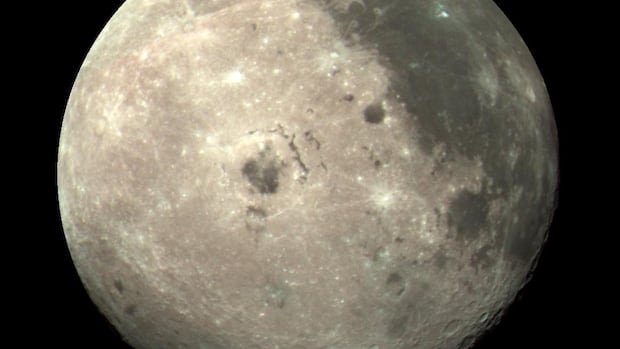

When Jeremy Hansen, a Canadian astronaut, embarks on the Artemis 2 mission beyond the moon, he will have the unique task of observing the far side of the moon, a perspective not visible from Earth. Meanwhile, scientists on Earth are eagerly monitoring this mission as they plan to send telescopes and robots to explore this hidden lunar terrain in the future.
The moon presents two distinct faces due to its gravitational lock with Earth, always showing one side to our planet and the other to outer space. Despite commonly being referred to as the “dark side,” the far side receives just as much sunlight as the Earth-facing side. It is characterized by a rugged surface with numerous craters, unlike the smoother, flat plains known as “Maria” on the near side.
One of the main attractions of the far side is its tranquility, shielded from Earth’s artificial radio interference, making it an ideal location for radio telescopes. Hansen’s journey will offer him a rare opportunity to witness sights that few have seen since the Apollo missions, as he will travel 7,500 kilometers beyond the moon, providing a unique global perspective.
Unlike the Apollo astronauts who orbited close to the equatorial regions, Hansen will have a broader view, encompassing the entire Earth alongside the moon simultaneously—a spectacle never before witnessed by human eyes.
During the Artemis mission’s flyby of the moon, detailed observations of the lunar surface will be made by the crew through the windows, leveraging the human eye’s ability to discern subtle details essential for potential landing missions. Cameras may overlook nuances in color and shading that indicate surface conditions like dust levels or roughness.
Among the planned missions for the far side, the Japanese TSUKUYOMI, or Lunar Meter Wave Telescope, aims to install a radio dish array to explore the universe’s early stages during the dark ages. Detecting faint radio signals emitted by neutral hydrogen gas from that era could provide insights into the role of dark matter in shaping the universe’s evolution.
The TSUKUYOMI prototype is set to land near the moon’s south pole in the late 2020s, complemented by other initiatives like the LuSEE Night radio observatory and NASA’s Farside Seismic Suite. Future plans by NASA and ESA involve lunar observatories in their nascent stages of development.
While human moon missions prioritize establishing colonies and seeking water ice at the south pole, landing sites will maintain a direct line of sight with Earth for communication. On the hidden far side of the moon, robots will silently gaze outward, delving into the mysteries of the universe’s origins and evolution.