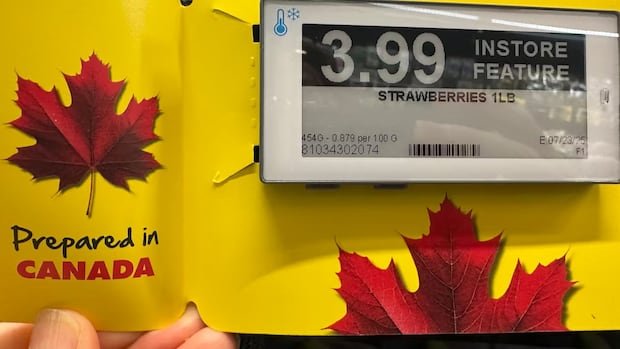

Canada’s food regulatory authority has imposed a $10,000 penalty on a Loblaw-owned establishment for falsely marketing imported products as Canadian. The Canadian Food Inspection Agency (CFIA) informed CBC News that a Toronto Superstore incorrectly utilized “maple leaf advertising decals” and a “Product of Canada” claim in an in-store exhibit to promote a foreign item. This led to a deceptive product advertisement regarding the product’s origin, as stated by the CFIA via email. The fine was issued on January 15, but the announcement was delayed until this week.
The CFIA has the authority to levy fines of up to $15,000 per violation. The specific product that triggered the penalty was not disclosed by either the federal agency or Loblaw. The Superstore, situated on Gerry Fitzgerald Drive in the city’s north end, acknowledged the challenge of ensuring accurate country-of-origin signage due to the extensive inventory they handle. Loblaw expressed regret for any confusion caused and emphasized ongoing efforts to enhance their processes.
The surge in the buy-Canadian movement last year, catalyzed by concerns over U.S. President Donald Trump’s trade policies and remarks about Canada, prompted grocers to capitalize on the trend by promoting domestic products with Canadian branding, sometimes inaccurately. The CFIA’s decision to penalize the Superstore came after a CBC News investigation last summer revealed major grocers misleadingly marketing imported goods as Canadian through tactics known as “maple washing.”
Federal regulations mandate that food labels and in-store signage must be truthful and non-deceptive. Instances of misinformation included a Toronto Sobeys featuring raw almonds with a Canadian maple leaf symbol and a “Made in Canada” declaration, despite almonds not being grown in Canada. Similarly, a Loblaw-owned Toronto No Frills presented strawberries with signage indicating Canadian origin, while the packaging revealed them as a product of the USA.
Despite public dissatisfaction over the lack of fines imposed on grocers engaging in “maple washing,” the CFIA emphasized its commitment to addressing food mislabelling and determining enforcement actions based on various factors. The agency is yet to respond to inquiries regarding why Sobeys did not face fines following an investigation into mislabelling at a Safeway store outside Edmonton.
Sheila Young, who reported mislabeling concerns to the CFIA, urged the agency to enforce fines promptly in such cases, emphasizing the need for accountability among grocers. The CFIA defines “Product of Canada” as food entirely or mostly produced in the country, while for a product to be labeled “Made in Canada,” the final significant transformation must occur within the country.