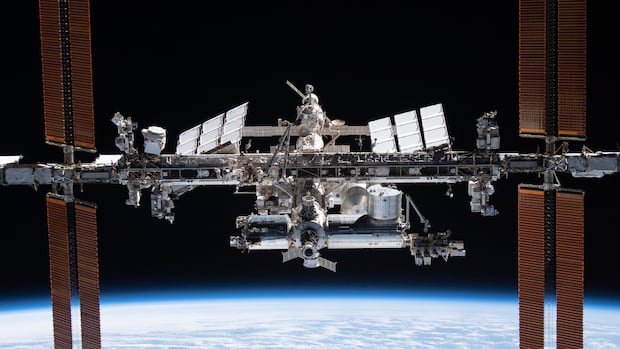

Historic structures, like Alexander Graham Bell’s residence in Nova Scotia, are typically transformed into museums or national historic sites to safeguard their legacy for future generations. But what about preserving a building the size of a football field that orbits 400 kilometers above the Earth?
NASA’s official strategy is to deorbit the International Space Station (ISS) at the end of its lifespan, intending to guide it in a controlled descent back into Earth’s atmosphere for a crash landing in a remote ocean location. However, recent U.S. government members have proposed legislation urging NASA to reconsider this approach and explore the possibility of storing the ISS in low Earth orbit instead.
Since 2000, the ISS has hosted numerous astronauts from the U.S., Russia, Canada, Europe, and Japan, assembled through multiple space shuttle and Russian launches. Weighing over 400 metric tonnes, it stands as the largest scientific laboratory ever deployed in space, facilitating countless experiments unique to a microgravity setting.
With its operational lifespan nearing its end, NASA announced in January 2022 that the ISS will be decommissioned by 2030 and deorbited in 2031. The current plan involves using a SpaceX rocket to guide it on a controlled reentry trajectory over the Pacific, similar to the fate of its predecessor, the Russian Space Station MIR, in 2001.
However, not everyone is in favor of this plan. U.S. Rep. George Whitesides, a former NASA chief of staff, presented a proposal to investigate alternative options before committing the ISS to destruction. The proposal gained initial bipartisan support, emphasizing the need to fully explore potential preservation avenues for this engineering marvel.
Efforts to boost the ISS to a higher orbit face challenges due to fuel requirements, structural stresses, and collision risks with space debris, as outlined in a 2024 NASA report. Despite considerations to transfer ownership to private entities, no viable proposals have emerged, leading to the likelihood of the ISS meeting its end in the Earth’s atmosphere.
While NASA shifts focus towards lunar and Mars missions, the concept of orbiting space stations persists, with China’s Tiangong station already operational and private ventures planning new space habitats. Proposals for innovative space structures, including rotating space hotels, hint at a future beyond the ISS era.
Rep. Whitesides’ bill, still pending further approval, underscores the ongoing debate surrounding the ISS’s fate. Despite the allure of preserving it as a heritage site, the practical challenges and costs make its incineration in the upper atmosphere and descent into the Pacific Ocean the most probable outcome, unless a groundbreaking alternative emerges.