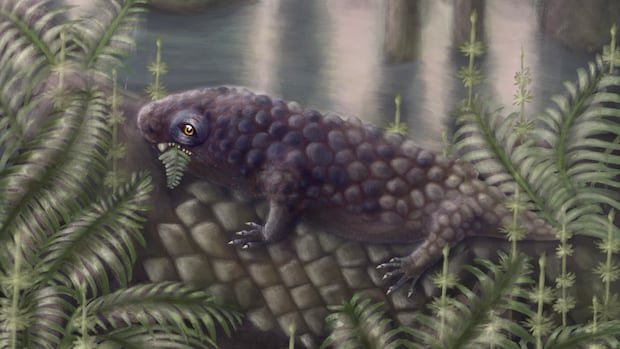

A newfound creature, about the size of a football, with unique teeth capable of consuming plants, possibly stands as one of the earliest plant-eating vertebrates on record. Identified as Tyrannoroter heberti, this species inhabited a ferny swamp on Cape Breton Island in Nova Scotia approximately 307 million years ago during the late Carboniferous Period. During this era, most four-legged animals primarily fed on other animals, lacking the ability to process leaves or bark.
Recently published research highlights Tyrannoroter as the earliest known tetrapod equipped with teeth suitable for a herbivorous diet, marking a significant shift in our understanding of this evolutionary transition. Arjan Mann, the lead author of the study published in Nature Ecology and Evolution, remarked on the importance of this discovery.
Tyrannoroter, classified as a “microsaur,” shares similarities with reptiles and mammals predating their existence. Notably, its skull was uncovered amidst various animal fossils entwined in the roots of a massive petrified tree stump on Cape Breton Island. The stump, discovered by amateur paleontologist Brian Hebert, who later received the honor of having the species named after him, measures around three to four meters across.
Mann, a paleontologist at the Field Museum of Natural History in Chicago, suggests that Tyrannoroter’s skull resembles that of pantylids, a group of microsaurs characterized by their short, stout bodies adapted for digging. While most pantylids were diminutive, Tyrannoroter was considered comparatively large, akin to the size of a football, hence its moniker, which translates to “tyrant digger.”
The standout feature of Tyrannoroter lies in its unique teeth arrangement, described as resembling “Hershey-kiss” shapes, specifically designed for consuming plant matter rich in fiber. These teeth exhibit additional rows or “batteries,” providing the necessary surface area for grinding, a trait uncommon among contemporaneous insect-eating animals.
Examining previously discovered fossils, researchers identified relatives of Tyrannoroter dating back to 318 million years with similar dental structures, suggesting an early specialization in plant-based diets within this animal group. This development sheds light on the transition of tetrapods to herbivory, a significant evolutionary milestone during the Carboniferous Period.
The emergence of herbivores carries substantial ecological implications, influencing plant communities and ecosystems. Robert Reisz, a paleontologist at the University of Toronto Mississauga, commends the research’s contribution to Canadian paleontology, emphasizing the need for further investigation into Tyrannoroter’s herbivorous tendencies to deepen our understanding of early tetrapod evolution.