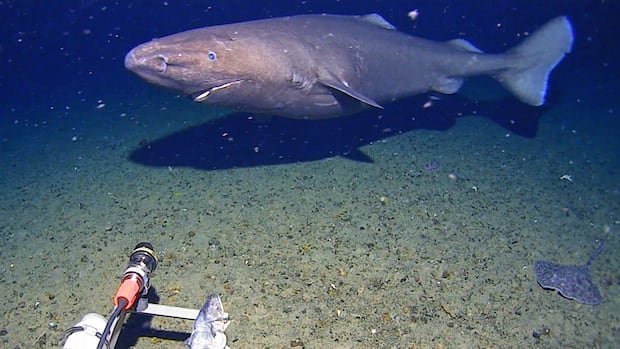

A large, robust shark was spotted swimming slowly over a desolate seabed in the deep, dark waters of Antarctica, defying previous beliefs that sharks did not inhabit these frigid regions. Researcher Alan Jamieson revealed the unexpected sighting of this sleeper shark captured on video in January 2025.
The impressive shark, estimated to be between three and four meters long, surprised the team exploring the area off the South Shetland Islands near the Antarctic Peninsula. The footage was obtained using a camera operated by the Minderoo-UWA Deep-Sea Research Centre, which studies ocean life in the deepest parts of the world.
The shark, found at a depth of 490 meters where the water temperature was a chilly 1.27 degrees Celsius, was observed alongside a skate, a shark relative resembling a stingray. Scientists had previously known that skates could be found as far south as this location.
According to Jamieson, who heads the University of Western Australia-based research center, this was the first recorded shark sighting in the Antarctic Ocean. Peter Kyne, a conservation biologist at Charles Darwin University, supported this claim, emphasizing the lack of historical records of sharks in such southern waters.
The presence of sharks in these colder regions could be linked to climate change and warming oceans, potentially driving them towards the Southern Hemisphere. However, due to the remote nature of Antarctica, data on range changes remains limited.
The sleeper shark population in the Antarctic Ocean is believed to be scarce and challenging for human detection. Jamieson highlighted the significance of the footage, indicating that the shark’s behavior and habitat depth shed light on the marine ecosystem in this region.
The Antarctic Ocean’s unique stratification, with distinct water layers stacked up to 1,000 meters deep, provides a complex environment for marine life. Jamieson speculated that other Antarctic sharks likely inhabit similar depths, feeding on the remains of marine creatures that sink to the seabed.
Research in Antarctic waters is constrained by seasonal limitations, with cameras typically operational only during the Southern Hemisphere summer months from December to February. This restricted monitoring period contributes to unexpected discoveries such as the recent shark sighting.