
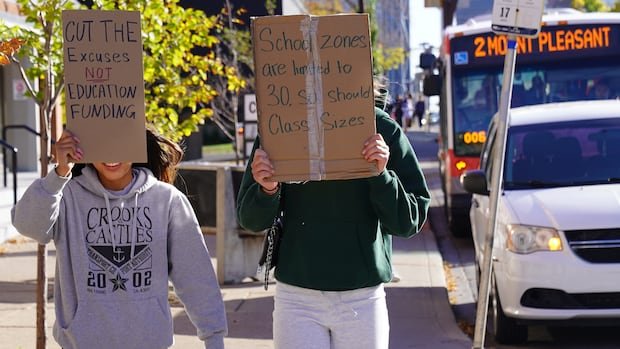

One of the main concerns in the ongoing teachers’ strike in Alberta revolves around the issue of class sizes. However, determining the exact size of classes has become challenging as the province no longer gathers specific data on this aspect.
Previously, Alberta used to release annual reports on class sizes, providing detailed information on the number of students in each class at over 1,500 schools across the province.
In 2019, the newly elected UCP government discontinued this practice.
The following year, the government altered the funding formula for school boards, transitioning from a yearly funding growth tied to enrollment to a three-year “weighted moving average” (WMA) model, causing concerns among larger school boards in rapidly growing urban areas.
Trisha Estabrooks, former chair of Edmonton Public Schools, expressed her discontent with the new funding model, emphasizing that it would base funding on past student numbers, making it challenging to keep up with current demands.
The change took effect in September 2020 during the COVID-19 pandemic, which witnessed a brief decline in enrollment followed by a surge. However, due to the formula’s reliance on previous enrollment figures, many school boards received reduced funding compared to the previous model.
Complaints about the funding model have persisted over the years, with larger school divisions experiencing funding shortfalls due to increasing enrollments.
The absence of recent class size data makes it hard to quantify the impact of the funding formula on class sizes. Nevertheless, by analyzing the growth of teaching staff in comparison to student enrollment since the formula change, some insights can be gleaned.
Exploring the Data
Through the provincial government’s annual budget documents, information on the number of “certificated staff” in full-time equivalent positions working for school boards is published, giving a general overview of the teaching workforce in the province.
Although not a precise measure, these figures provide a broad comparison of teaching staff growth versus student enrollment growth at a provincial level. An observable trend shows that teaching staff and student enrollment closely aligned until around 2021, after which enrollment growth surpassed staff growth.
This trend has persisted until the 2025 school year, with student enrollment growing by 15% since 2016-17, while teaching staff increased by only 8%.
Educational policy studies professor Darryl Hunter cautioned that the available data alone does not conclusively attribute the gap between student enrollment and teaching staff to the funding formula change.
However, school board officials have directly linked the WMA formula to larger class sizes and funding deficits in the past.
In response to ongoing concerns, the government introduced a new two-year weighted average funding formula for the 2025-26 budget, aiming to offer more responsive funding tailored to urban growth while supporting rural schools.
Education Minister Demetrios Nicolaides emphasized that the revised formula provides school boards with greater flexibility in staffing decisions, eliminating the need for class size reporting.
Despite these changes, the Alberta Teachers’ Association advocates for further actions to address teacher shortages in the province, citing a report from 2003 recommending the hiring of over 5,000 new teachers to meet optimal pupil-teacher ratios.
While detailed class-size reporting ceased in 2019, tracking by Edmonton Public Schools suggests that many schools still contend with larger class sizes than recommended. Anecdotal evidence from various school divisions also indicates exceeding recommended class sizes, although precise figures are scarce.
Professor Hunter emphasized the importance of transparent data on class sizes, highlighting it as a key performance indicator necessary for public awareness in a democratic system.