
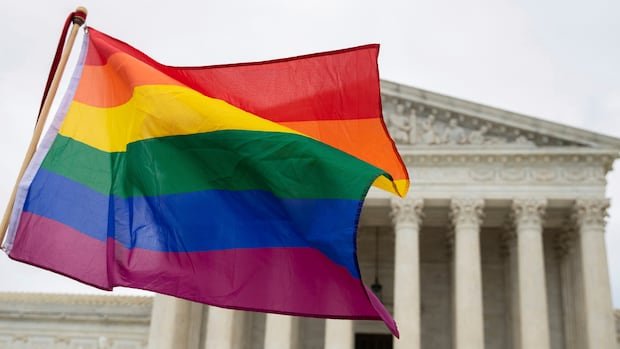

The U.S. Supreme Court declined a request from a former Kentucky county official to reverse its significant 2015 decision legalizing same-sex marriage across the country. This move by the justices marks their avoidance of the contentious case more than three years after their conservative majority altered abortion rights.
Former Kentucky county clerk Kim Davis, an Apostolic Christian, had her appeal turned down by the court, which has a 6-3 conservative majority. Davis faced a lawsuit from a gay couple after she refused to issue any marriage licenses following the 2015 ruling that established a constitutional right to same-sex marriage, citing conflicts with her religious beliefs.
Despite Davis’s argument that the First Amendment’s right to free exercise of religion should shield her from liability, lower courts dismissed her claim. She was then instructed to pay over $360,000 in damages and legal fees for infringing on a same-sex couple’s marriage rights.
The 2015 Obergefell v. Hodges decision was a pivotal win for LGBTQ rights in the U.S., asserting that states cannot prohibit same-sex marriages under the Constitution’s due process and equal protection guarantees.
Overturning the Obergefell ruling would empower states to once again enact laws against same-sex marriage. The dissenting opinion in the 5-4 Obergefell decision came from four conservative justices, including Clarence Thomas, John Roberts, and Samuel Alito, who are still active on the court.
In a separate instance, the court’s shift towards conservatism was evident when it overturned the landmark 1973 Roe v. Wade ruling in 2022, which recognized a woman’s constitutional right to abortion nationwide. This move fueled hopes among conservatives and Republicans opposed to Obergefell that the court might reconsider the same-sex marriage right.
Davis, who faced legal repercussions for her refusal to issue marriage licenses, was involved in a civil rights lawsuit filed by David Ermold and David Moore. The couple accused her of violating their constitutional right to marry, as acknowledged in the Obergefell decision. Despite Davis’s claims of protected religious beliefs, courts ruled against her, emphasizing that public officials must uphold constitutional rights even if they conflict with personal beliefs.
The Cincinnati-based 6th U.S. Circuit Court of Appeals also rejected Davis’s arguments, stating that government officials’ actions do not receive First Amendment protection when carrying out official duties. Davis’s attempt to challenge the Obergefell ruling was deemed waived by the court during the case’s early stages.
In her plea to the Supreme Court, Davis’s legal team contended that the right to same-sex marriage, similar to the overturned abortion right, is based on a legal concept called “substantive due process.” The Supreme Court had previously dismissed an appeal by Davis in 2020 at an earlier phase of the legal dispute.
Justice Thomas, along with Justice Alito, highlighted the perceived negative impact on religious liberty resulting from the same-sex marriage ruling.