
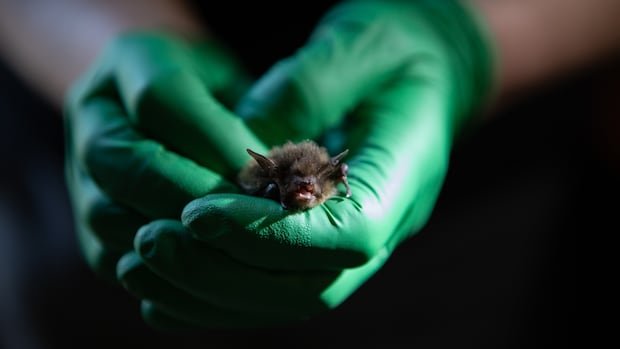

As evening descends upon a spacious country estate in Snohomish County, Washington state, a group of twelve volunteers congregates around Abby Tobin, a scientist from the Washington State Department of Fish and Wildlife. Tobin predicts the bats will soon become restless and proceeds to brief the group on their task: capturing as many bats as possible.
Their primary objective is to detect signs of the fungus responsible for white-nose syndrome, a disease that has been devastating bat populations in eastern North America for approximately 15 years. The fungus, identified as Pseudogymnoascus destructans, infects the bats’ skin, disrupting their hibernation patterns and leading to dehydration, starvation, and eventual death.
Cori Lausen, a researcher based in British Columbia known as the “Bat Lady,” is exploring a potential solution involving a probiotic formula to combat the syndrome. The B.C. government reports that white-nose syndrome has claimed over six million bats in eastern North America since 2006, resulting in a significant decline in bat populations across regions like Quebec.
The loss of bats poses a threat to the ecosystem as these creatures serve as natural pest control agents, consuming large quantities of insects each night. Their role in reducing the need for pesticides benefits agriculture, minimizes pollution, and enhances food security. A study published in a 2024 issue of the academic journal Science suggests that regions affected by white-nose syndrome may experience an eight percent rise in human infant mortality rates due to increased pesticide usage resulting from declining bat populations.
Apart from white-nose syndrome, habitat destruction from deforestation and the impact of wind turbines on migratory bats are additional concerns for researchers like Lausen. To address these challenges, Lausen has developed a probiotic cocktail comprised of four bacterial strains that may inhibit the fungus, offering hope for bat conservation efforts.
In preparation for winter, Lausen is applying the probiotic cocktail at the Hayward Recreation Site near Stave Lake in B.C., close to the U.S. border. Early indications suggest that the probiotic treatment is yielding positive results in helping bats combat the fungus.
Collaborative efforts between Canadian and American researchers are underway to assess the effectiveness of the probiotic solution in protecting bats from white-nose syndrome. In Snohomish County, volunteers work diligently to capture bats for examination, checking for symptoms of white-nose syndrome and potential traces of the probiotic cocktail.
Despite the challenges posed by the elusive nature of western bat populations, research and conservation efforts persist to safeguard these vital creatures from white-nose syndrome and other threats. Lausen remains dedicated to preserving bat populations, emphasizing the urgency of identifying effective treatments before irreversible consequences occur.