
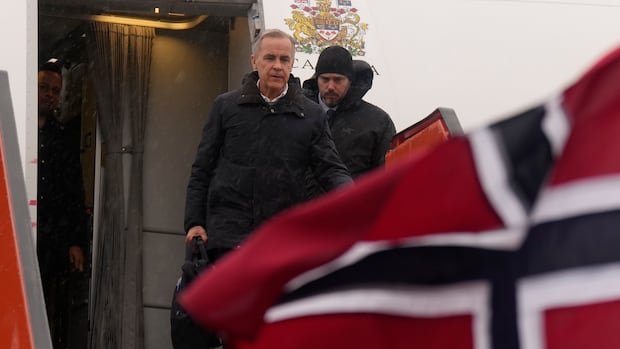

Prime Minister Mark Carney arrived in Norway early Friday for crucial meetings with the country’s leader and the German chancellor. The visit precedes his attendance at a significant NATO wargaming exercise involving Canadian troops.
Norway and Germany are jointly supporting a proposal from German submarine manufacturer TKMS to supply Canada with 12 new submarines, a substantial program accelerated by the Liberal government. Despite the substantial military, economic, and diplomatic implications, Carney stated that he does not anticipate discussions about the submarine bid during the meetings.
Both TKMS and the competing bidder, South Korea’s Hanwha Ocean, have submitted their proposals to Canada’s defense investment agency. The final decision is expected by early April, with a potential announcement as early as late June.
The collaboration between Germany and Norway emphasizes North Atlantic unity and longstanding NATO cooperation, highlighting the mutual benefits of utilizing the same submarine models across the three nations. TKMS is offering the Type 212CD, an updated version of the Type 212 submarine already in service with several navies.
While the submarine bid may not be directly addressed during the meetings, discussions on allied cooperation are likely to take place. Micheal Byers, a political and defense expert, noted the importance of such discussions in fostering collaboration among allies.
The leaders will convene in Bardufoss, above the Arctic Circle, to observe the ongoing Cold Response exercise involving over 25,000 NATO personnel from 14 countries. Canadian troops’ participation is not only a display of solidarity but also an opportunity to share valuable Arctic operational experience with other troops.
The addition of civilians in this iteration of the exercise is crucial in simulating real-world scenarios where the impact on civilian populations must be considered. Keir Giles, a defense expert, highlighted the importance of factoring in civilian involvement in war simulations.
Lessons learned from the NATO exercise will be essential in understanding how to engage and mobilize populations during a crisis. The exercise aims not only to ensure survival but also to bolster societal resilience and maintain functional societies and economies in the face of adversarial threats.