
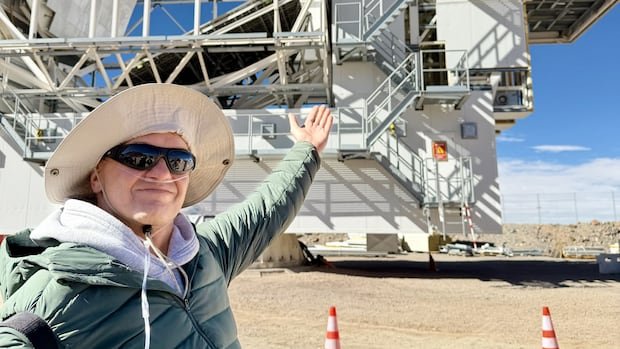

A team of Canadian researchers is pivotal to a groundbreaking new telescope poised to unveil profound mysteries of the universe. Situated at an extraordinary altitude in Chile’s Atacama Desert, the Fred Young Submillimeter Telescope stands 5,600 meters above sea level, surpassing even the Mount Everest base camp. This height, coupled with the desert’s arid conditions, ensures unparalleled visibility by minimizing interference from water vapor and atmospheric elements.
Mike Fich, the leading Canadian astronomer from the University of Waterloo, marvels at the telescope’s unparalleled clarity, rivaling space-based capabilities but at a fraction of the cost. Valued at approximately $40 million, the telescope is a collaborative effort led by Cornell University’s CCAT Observatory in New York, working alongside institutions from Chile, Germany, and Canada.
The project aims to shed light on the formation and dynamics of stars and galaxies, as well as unravel mysteries surrounding dark energy and dark matter. With a broader field of view than traditional telescopes, it can swiftly scan and map vast portions of the sky. The telescope’s cutting-edge technology includes quantum sensor cameras operating near absolute zero, enabling the detection of submillimeter wavelengths invisible to the naked eye and other instruments.
This groundbreaking initiative, involving researchers from various Canadian institutions, promises to offer unprecedented insights into the universe’s evolution. By gazing into the distant past as light travels across galaxies, the telescope will track the ancient movements and formations of celestial bodies. The project’s German partners are establishing a dedicated computing center to manage the extensive data output, with Canadian researchers at the forefront of developing innovative camera modules for the telescope.
Amidst the challenges of constructing and operating at such extreme altitudes, the team remains dedicated to harnessing the telescope’s potential. With cameras set for installation this summer and initial data anticipated by mid-fall, the scientific community eagerly awaits the transformative discoveries that lie ahead.