
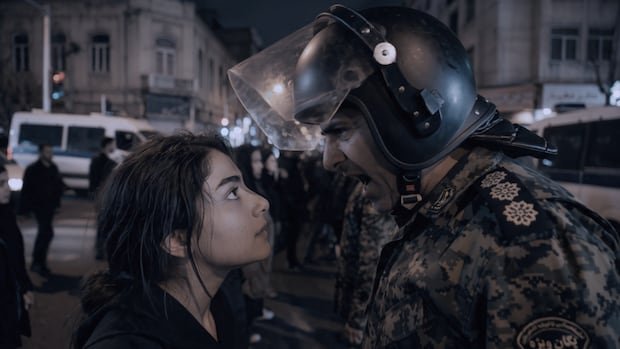

The Tribeca Festival is standing by its decision to feature a full-length AI-generated movie in its lineup this year. “Dreams of Violets,” a 74-minute film depicting the Iranian resistance, was created without the use of cameras or actors. Filmmakers Ash and Pooya Koosha utilized AI tools to produce the movie at a mere cost of $2,000 US.
The film’s trailer on YouTube describes “Dreams of Violets” as a docudrama feature inspired by real events spanning 47 years of Iranian civilian resistance. The storyline follows five strangers witnessing protest footage, culminating in a dramatic encounter with a violent soldier and a young boy in a wheelchair.
Iran has experienced widespread protests against its regime in recent years, triggered by issues such as the actions of its morality police, mandatory hijabs, and economic challenges. Despite facing criticism for its use of AI, the film has garnered attention for its innovative approach.
Tribeca co-founder Jane Rosenthal addressed concerns, emphasizing the festival’s support for boundary-pushing artists and innovative storytelling. She praised “Dreams of Violets” as a prime example of utilizing AI for human-centric storytelling and emotional impact.
While the film is set to debut on June 10 in New York City, it is not the first production to spark debate over AI’s role in media. Various filmmakers have voiced differing opinions on incorporating AI into their projects, with some welcoming the technology’s potential and others expressing reservations.
Director Ash Koosha, the creative force behind “Dreams of Violets,” views AI as a unique storytelling medium akin to animation. Motivated by events in his homeland, Koosha harnessed AI tools to bring his vision to life in a cost-effective and efficient manner.
As the film industry navigates the integration of AI, concerns have been raised regarding its impact on traditional storytelling and job market dynamics. Industry experts emphasize the need for a broader conversation on AI’s implications across various sectors, including film and television.
Richard Lachman, a digital media professor, highlights the dual nature of AI’s influence on film festivals, noting both the democratizing potential it offers and the challenges in audience perception. While AI presents opportunities for diverse storytelling, there are lingering questions about how viewers discern AI-generated content from reality.
In a rapidly evolving landscape where technology intersects with creativity, the debate surrounding AI in filmmaking continues to evolve, shaping the future of storytelling and artistic expression.