
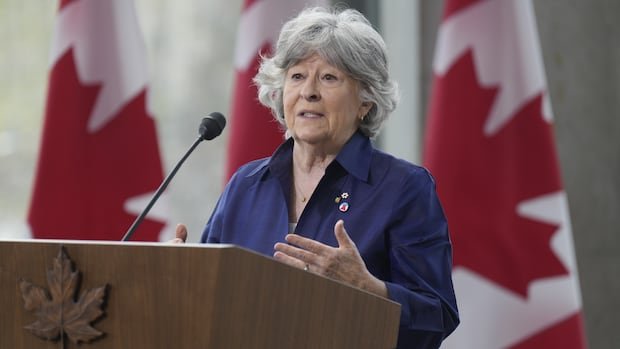

Former Supreme Court Justice Louise Arbour, renowned for her principled stances, has had a distinguished career in Canada and internationally. Born in 1947 in Montreal to a low-income, single-parent household, Arbour graduated with distinction in law from l’Université de Montréal in 1970 and was called to the Ontario bar in 1977.
Over the years, the now 79-year-old has held significant positions such as chief prosecutor for the international criminal tribunals for the former Yugoslavia and Rwanda, UN High Commissioner for Human Rights, and CEO of the International Crisis Group. Her journey began with a clerkship under former Supreme Court Justice Louis-Philippe Pigeon post-graduation, followed by roles at the Law Reform Commission and as a professor at Osgoode Hall, York University.
In 1987, she rose to the position of associate dean at Osgoode Hall before being appointed to the bench of what was then the Supreme Court of Ontario, later elevated to Ontario’s Court of Appeal. Arbour’s fearless advocacy for justice was evident early on, notably in her impactful report on conditions at a women’s prison in Kingston, Ontario, emphasizing the need to limit segregation for better mental health outcomes.
As the chief prosecutor for the international criminal tribunals in The Hague, Arbour made history with the first genocide conviction by an international tribunal since the 1948 Geneva Convention, among other notable achievements. Her tenure saw significant developments in international law, including indictments of high-ranking officials for war crimes.
Arbour’s judicial career in Canada was marked by progressive stances, including dissenting opinions on issues like the decriminalization of marijuana. Despite facing controversy, particularly during her term as UN High Commissioner for Human Rights, where she criticized the U.S.-led war on terror and advocated for civilian protection, Arbour remained steadfast in her pursuit of justice.
In her role as the UN Secretary-General’s special representative for international migration, Arbour played a pivotal role in developing the Global Compact for Migration, aiming to address the challenges posed by global migration. While some, like former Conservative leader Andrew Scheer, expressed concerns about the compact, others, including former prime minister Stephen Harper’s immigration minister Chris Alexander, clarified that it was non-binding and did not infringe on sovereignty.
Arbour’s recent involvement in investigating sexual harassment in the military highlighted systemic issues and led to changes in the prosecution of misconduct. Additionally, her advocacy for 2SLGBTQ+ rights and past rulings affirming equality and inclusivity reflect her commitment to upholding fundamental rights and values.
The multifaceted and impactful career of Louise Arbour continues to leave a lasting legacy in the realms of law, human rights, and international justice.