
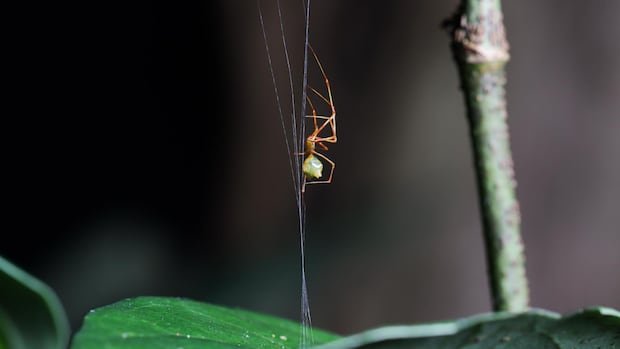

A biologist named Ajay Narendra recently shared insights on a fascinating discovery involving a spider species found in the tropical rainforests of Australia. This spider has amazed researchers with its unique hunting method that involves catapulting prey using a silk trap equipped with a spring mechanism. The study detailing this behavior was recently published in the journal Current Biology, showcasing how the spider, known informally as the “ballista spider,” uses a cone-shaped snare to launch green tree ants into its web.
The spider, belonging to the Propostira genus and yet to be formally classified, was first spotted by researcher Greg Anderson in 2022 in a remote rainforest on Queensland’s Cape York Peninsula. This initial observation led a team from Macquarie University to investigate further in 2023, where they utilized high-speed cameras to document the spider’s hunting technique over a 10-day period. The spiders, which are nocturnal and measure between three to five millimeters in length, spend their daylight hours concealed under leaves before emerging at dusk to construct intricate traps beneath their webs.
To ensnare their prey, the spiders descend and attach silk tension lines to a lower anchor point, forming a cone structure that is then wrapped in finer silk. When green tree ants bite the cone, they become trapped. As the ant struggles, the tension is released, propelling the insect up to nearly 30 centimeters into the air before landing in the spider’s main web. The quick and efficient nature of this hunting strategy caught the researchers by surprise, with the entire process unfolding in mere milliseconds.
Researchers noted that the green tree ants were drawn to the silk trap within a minute of its completion, leading to speculation that specific pheromones may be involved in attracting these particular ants. Ajay Narendra emphasized the meticulous nature of the spider’s prey specialization, targeting green tree ants due to their formidable nature and strength in numbers.
Further analysis of the spider silk is planned to identify any pheromones utilized in this unique hunting tactic. Saad Bhamla, an associate professor at the University of Colorado-Boulder’s BioFrontiers Institute, suggested that the vigilant and territorial behavior of green tree ants could play a significant role in their interaction with the spider. The launch mechanism employed by the ballista spider exerts considerable force on its prey, far surpassing the G-forces experienced by jet pilots and exceeding those generated by other spider species with similar hunting methods.
The study underscores the ongoing discoveries in the natural world, highlighting the complexity and ingenuity of species like the ballista spider. Researchers continue to delve into the intricacies of this spider’s hunting behavior, shedding light on the remarkable adaptations found in the animal kingdom.