
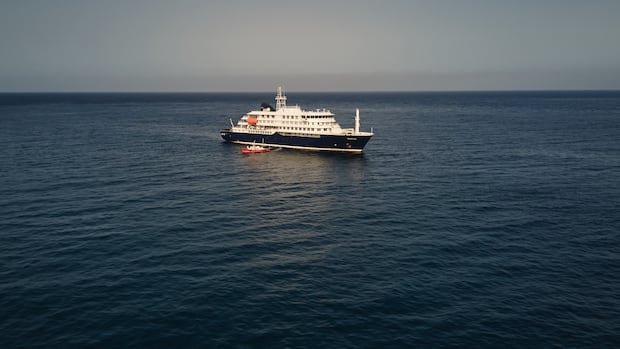

Spanish authorities are making arrangements to receive over 140 passengers and crew members onboard a cruise ship affected by hantavirus, bound for the Canary Islands. Health officials in the Canary Islands are set to conduct careful evacuations upon the ship’s expected arrival on Sunday at the island of Tenerife. Passengers will be relocated to a secluded and restricted area, as stated by Virginia Barcones, the head of Spain’s emergency services. Both the United States and the United Kingdom have agreed to send aircraft to evacuate their citizens from the cruise ship. Canadian consular officials are on their way to meet with four Canadians who are still on board the vessel.
Although three individuals have died and five passengers who disembarked the ship have been confirmed to be infected with hantavirus, the cruise operator Oceanwide Expeditions has reported that there are no symptomatic cases onboard the Dutch-flagged ship, MV Hondius. The World Health Organization has indicated that the risk of a wider public outbreak from this incident is low.
Recent developments include the negative hantavirus test result of a flight attendant who briefly interacted with an infected cruise passenger. This situation had sparked concerns about potential virus transmission. Christian Lindmeier, a WHO spokesperson, emphasized that the risk remains minimal and clarified that hantavirus does not present the same threat as COVID-19.
Hantavirus is primarily transmitted through contaminated rodent droppings and is not easily transmissible between individuals. However, the Andes virus strain identified in the cruise ship outbreak may have rare cases of human-to-human transmission. Symptoms typically manifest between one to eight weeks after exposure.
Health authorities worldwide are actively tracing and monitoring passengers who left the ship before the outbreak was detected. Efforts are underway to trace individuals who may have had contact with these passengers since then. It was only on May 2 that health authorities confirmed the presence of hantavirus in a ship passenger.
Two Canadians who disembarked from the ship are currently isolating at home in Ontario, along with a third Canadian who had potential contact with an infected individual. The third Canadian is isolating in Quebec. In the UK, a British national on Tristan da Cunha, a remote British overseas territory, is suspected of being infected with hantavirus.
Amid ongoing investigations, a woman in Alicante, Spain, is being tested for hantavirus symptoms. She was on the same flight as a Dutch woman who passed away in Johannesburg after contracting the virus on the cruise ship. Two other Britons from the ship have tested positive for the virus, with one hospitalized in the Netherlands and the other in South Africa.
Authorities in South Africa are actively tracing contacts of passengers who disembarked from the ship. They are particularly focusing on a flight from St. Helena to Johannesburg on April 25, following passenger disembarkation on the island.
Spanish health officials are ensuring public safety measures in the Canary Islands and planning for the evacuation of passengers from the ship to repatriation flights. Special transportation arrangements will be made to ensure isolated travel for passengers, with cordoned-off areas designated at the airport to prevent contact with the general population. Spain has requested medically equipped aircraft to handle any symptomatic passengers and prevent potential transmission.
Overall, efforts are being made to contain the situation and safeguard public health in light of the hantavirus outbreak on the cruise ship.