
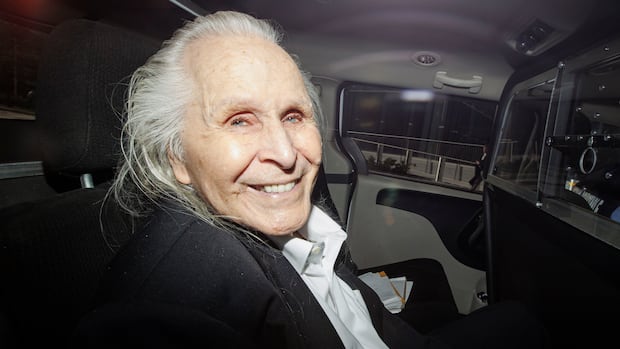

On Monday, the Ontario Court of Appeal reviewed Peter Nygard’s appeal concerning his convictions for sexual assault and the associated prison sentence. His legal team contended that the judge from the Toronto trial committed mistakes, particularly by allowing the testimony of a trauma expert.
In 2023, the former fashion executive was found guilty of four counts of sexual assault and received an 11-year prison sentence after numerous women presented allegations that spanned from the 1980s to the mid-2000s.
With credit for the time he had already spent in custody before and during the trial, Nygard’s effective prison term is just under seven years.
In 2024, Nygard’s attorneys submitted a notice of appeal, claiming that his sentence was overly harsh and that the trial judge incorrectly permitted clinical psychologist Lori Haskell’s testimony regarding trauma effects.
The defense referenced the case of Canadian musician Jacob Hoggard, whose appeal in relation to a 2022 sexual assault conviction also questioned Haskell’s testimony due to potential jury misinterpretation. However, Hoggard’s conviction was upheld by a panel that determined no miscarriage of justice occurred.
In their written arguments to the Appeal Court, the Crown contended that including Haskell’s testimony at Nygard’s trial was a “harmless error” that did not mislead the jury or result in a miscarriage of justice.
-
Peter Nygard files lawsuit alleging abuse of process, defamation following Winnipeg sex assault prosecution
-
Peter Nygard’s charges stayed in Winnipeg sexual assault case after judge rules right to fair trial breached
At 84 years old, Nygard was denied bail in 2024. The presiding judge stated in her ruling that she believed the inclusion of Haskell’s testimony represented the sole “legally plausible” argument presented in his appeal.
Additionally, Nygard’s attorneys claimed that the trial judge made an error by allowing the jury to use the evidence from one complainant to evaluate the strength of the Crown’s case concerning other complainants.
Nygard is seeking to have his conviction overturned or set aside and is requesting a new trial, along with a reduced sentence and any other relief the Appeal Court finds suitable.
In 1967, Nygard established his now-defunct global women’s apparel company in Winnipeg. He resigned as chairman following a raid by the FBI and police on his New York offices in February 2020.
Nygard also faced criminal accusations in Manitoba, but those charges were stayed in October after a judge found that records of police interviews with a complainant from 1993 had been destroyed without valid justification, infringing on his Charter right to a fair trial.
In 2020, prosecutors opted not to file charges, but the Manitoba government later referred the investigation to Saskatchewan Justice for an independent review, resulting in Nygard’s arrest.
Last month, Nygard’s legal team initiated a lawsuit against the governments of Manitoba and Saskatchewan, Winnipeg police, and others, claiming defamation and abuse of process related to those charges. These allegations have yet to be adjudicated in court.
Nygard is also facing a trial for sexual charges in Quebec and is subject to extradition to the United States on charges of sex trafficking and racketeering. He has denied all accusations made against him.