

Hidden in a dim cultivation chamber deep within a research facility at Acadia University, a lumpy white substance emerges from an industrial tray.
Resembling meringue, snow, or spray-foam insulation, this peculiar living entity known as mycelium — the root system of a mushroom — exhibits characteristics of independent growth.
Collaborating with an entrepreneur, researchers at Acadia are refining a process aimed at utilizing mycelium to create a high-protein powder for the commercial food industry.
The brainchild behind this initiative is Katie McNeill, who nurtured a seed of an idea several years ago.

With a background in agriculture, McNeill observed the wastage of certain agricultural food products in the Valley — either incinerated or discarded in landfills. Recognizing their potential, she embarked on her journey.
“I stumbled upon literature suggesting that it could be well-suited for cultivating a high-protein mushroom,” she remarks.
Teaming up with Allison Walker, a biologist at Acadia, they selected a specific food waste source from a food-grade facility in the Valley for mycelium cultivation, keeping the specifics confidential for proprietary reasons.
Through trials with various mushroom species, temperature variations, and humidity levels, they identified the optimal growth conditions.
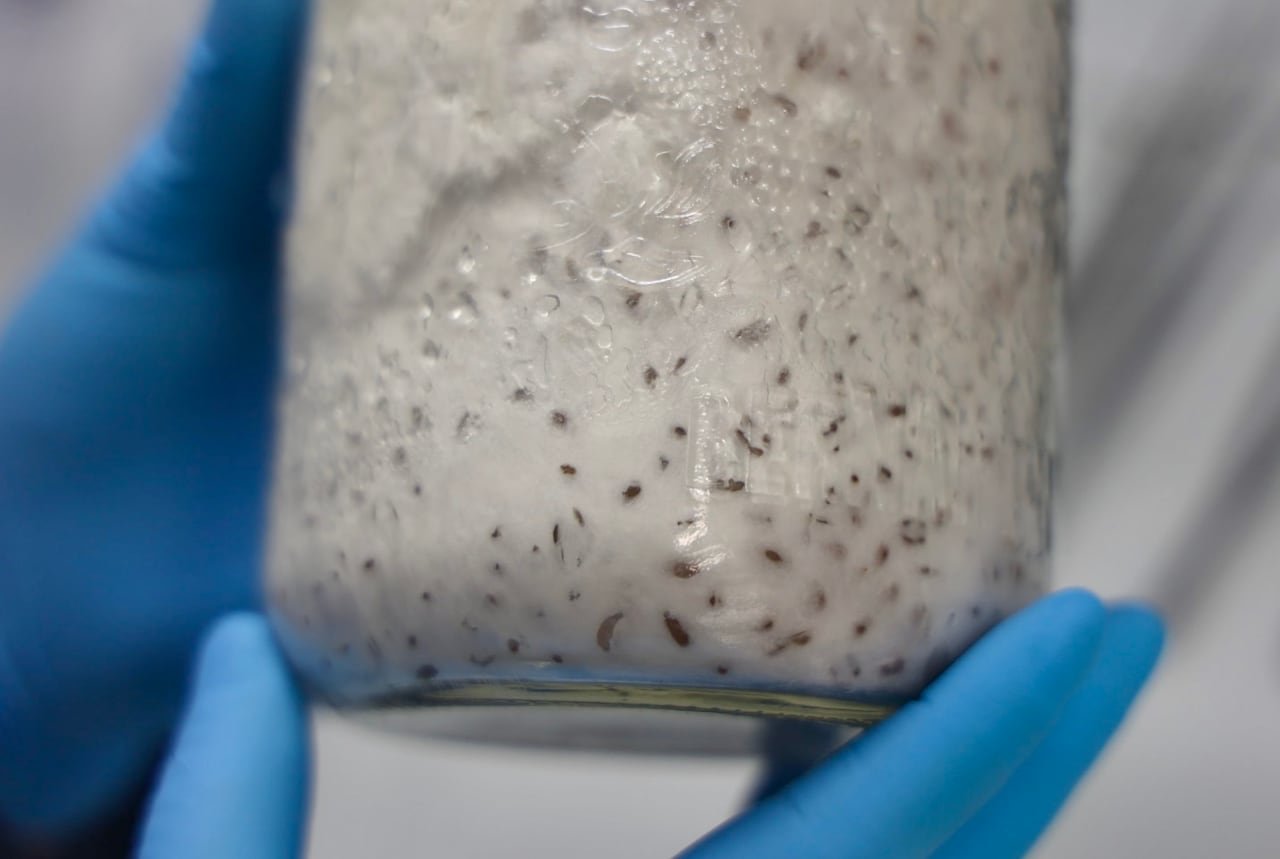
Walker details their initial step of creating a mycelium-infused liquid broth mixed with food waste, allowing the mycelium to flourish for a period to reach optimal growth before transferring it to trays.
“Unlike wild mushrooms that grow downwards into the soil, we aim to encourage upward growth,” Walker explains. “We aim to restrict the growth before mushroom production, completing the process from inception to harvest within a week to 10 days.”
Rich in protein, low in resources
While conventional mushrooms contain about 90% water and typically have around 2% protein content, the mycelium produced by Walker and McNeill boasts a protein content of approximately 40%.
McNeill compares this to hemp protein, slightly lower than pea or soy protein which usually undergo isolation processes.
While some companies in Canada and the U.S. offer mycelium protein derived from large vats creating sludge for powder conversion, McNeill, under her company Mycaro, aims to maintain a minimal processing approach, prioritizing a product closely resembling food.
Emphasizing sustainability as a key selling point, McNeill highlights the utilization of agricultural food waste that would otherwise be discarded, along with the reduced energy requirements compared to other protein sources.
Unlike land- and water-intensive sources like meat, soy, or pea protein, Mycaro’s production method involves indoor operations using vertical farming techniques, which involve stacked trays in a controlled setting.
Although most vertical farming setups necessitate lighting, consuming substantial energy, mushrooms and mycelium thrive in darkness, mitigating a significant energy demand.
McNeill envisions harnessing sustainable energy sources to power her future endeavors.
<h