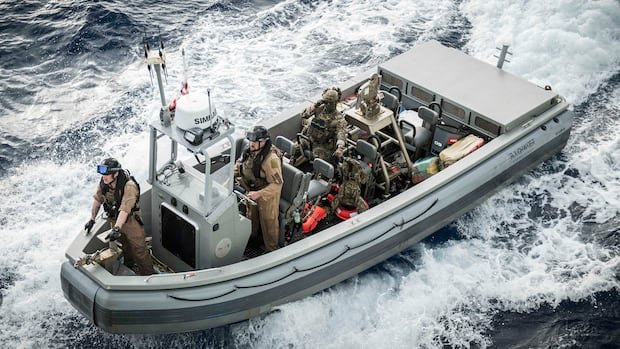

Canada’s Department of National Defence has affirmed its commitment to maintaining its collaboration with the U.S. Coast Guard in an enduring operation aimed at apprehending drug smugglers in the Caribbean. Despite recent deadly U.S. airstrikes in the region, Operation Caribbe, which has been ongoing since 2006, involves joint efforts by the Royal Canadian Navy and Royal Canadian Air Force with the U.S. Coast Guard to intercept and halt suspected drug-carrying vessels in the Caribbean, transferring any detainees to the U.S. for legal action.
In contrast to the U.S. Air Force’s recent actions of bombing four suspected drug vessels and resulting in the deaths of 21 individuals, Canadian officials have emphasized that these attacks are unrelated to Canadian military or intelligence personnel in the region. The Department of National Defence spokesperson, Cheryl Forrest, clarified that the Canadian Armed Forces’ activities under Operation Caribbe, carried out in cooperation with the United States Coast Guard, are distinct from the aforementioned U.S. military operations.
Operation Caribbe serves as Canada’s contribution to a broader international initiative known as Campaign Martillo, which involves 14 countries spanning from the Americas to Europe. Tim Addison, the Naval Association of Canada’s director of naval affairs, expressed concerns regarding the recent U.S. strikes and emphasized the importance of seeking clarity from the United States on the rationale behind the attacks.
Amidst ongoing debates on the legality of the airstrikes, various scholars and organizations, including Human Rights Watch, have raised doubts concerning the legitimacy of the strikes, labeling them as “extrajudicial killings.” Addison underscored the need for Canada to assess the situation carefully and make informed decisions regarding its continued involvement in Operation Caribbe.
As discussions unfold around the U.S. strikes and their implications, Eric Ouellet, a defense studies professor at Canadian Forces College and the Royal Military College of Canada, emphasized the importance of Canada maintaining a cautious approach towards its Caribbean deployments, particularly with regards to Venezuela. Ouellet raised concerns about potential intelligence sharing leading to operations that may violate international law and highlighted the significance of focusing on combating various illicit activities in the region.
The ongoing tensions and complexities within the Canada-U.S. relationship, especially amid negotiations for a new trade agreement, have placed the Royal Canadian Navy in a challenging position in the Caribbean. Ouellet suggested that ending Operation Caribbe prematurely would be a loss for both Canada and the United States, emphasizing the need for strategic navigation to address concerns effectively.
Furthermore, recent statements from U.S. officials, including President Trump and key cabinet members, suggest that the airstrikes targeted designated terrorist organizations involved in drug trafficking, specifically citing groups like the Venezuelan gang Tren de Aragua. The U.S. has attributed the surge in drug activities to Venezuela, particularly pointing fingers at President Nicolas Maduro, escalating tensions between the two nations.
Operation Caribbe, overseen by the U.S. Coast Guard Rear Admiral Mark Fedor, has focused on capturing low-level operatives affiliated with drug cartels to gather intelligence and disrupt their networks. Since its inception in 2006, Operation Caribbe has successfully intercepted 123 metric tonnes of cocaine, underscoring its impact in combating drug smuggling activities in the Caribbean region.