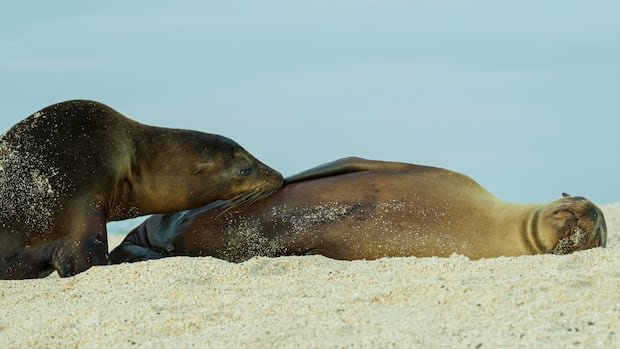

A recent study led by researcher Alexandra Childs has shed light on the peculiar behavior of fully grown Galápagos Islands sea lions that continue to nurse from their mothers well into adulthood. Childs, a PhD candidate in behavioral and marine biology at Germany’s University of Bielefeld, expressed astonishment at the phenomenon, describing it as a mind-blowing sight that challenged conventional expectations.
The study, detailed in the journal American Naturalist, revealed that approximately 11% of the sea lion population in the Galápagos exhibited this behavior, termed “supersuckling.” Childs likened this prolonged nursing to humans breastfeeding into their teenage and adult years, emphasizing the mystery surrounding why mothers allow such behavior despite the offspring’s ability to fend for themselves.
Analyzing two decades of data from the Galápagos sea lion population, the researchers found that most sea lions weaned from their mothers between 1.5 and 4.5 years, aligning with typical expectations. However, the supersucklers defied this trend by persisting beyond the weaning age threshold.
The study highlighted instances of “multigenerational suckling trains,” where multiple sea lions engaged in nursing simultaneously, showcasing a unique social dynamic within the species. While similar behaviors have been observed in other sea lion and seal species, the extent of supersuckling in the Galápagos sea lions stood out as particularly pronounced.
Experts like Andrew Trites from the University of British Columbia’s Marine Mammal Research Unit noted that supersuckling is often linked to food scarcity, with mothers ensuring their offspring receive sufficient nourishment for growth and survival. However, the study also pointed out that the behavior was more prevalent during periods of abundant food resources, challenging existing assumptions.
Childs proposed several theories to explain the Galápagos sea lions’ supersuckling behavior, suggesting possible immunological or social benefits that warrant further investigation. As research on this intriguing phenomenon continues, the complexities underlying this unique behavior remain a subject of ongoing inquiry.