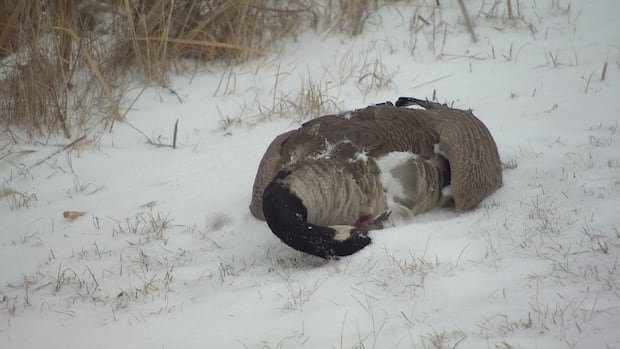
DISCLAIMER: This article includes an image showing a deceased goose.
The Canadian Food Inspection Agency has identified a highly transmissible form of avian flu in numerous samples collected in southern Manitoba following an unprecedented bird die-off.
During early December, approximately 500 bird carcasses, predominantly Canada geese, were discovered close to waterways in southern Manitoba. While separate groups of dead birds were spotted near the Red River north of Winnipeg’s Perimeter Highway, the largest concentration was found in a set of ponds in Niverville.
Biologist Frank Baldwin from the Canadian Wildlife Service informed CBC News that bird samples, which tested positive for avian influenza, commonly referred to as bird flu, were sent to the Canadian Food Inspection Agency to ascertain the infection strain.
A spokesperson for the federal agency stated that on December 11, 39 wild bird samples were submitted to the National Centre for Foreign Animal Disease for analysis. The inspection confirmed that 38 of the samples were positive for the highly pathogenic H5N1 strain of avian flu.
University of Manitoba researcher Hannah Wallace, specializing in viral immunology, expressed relief that the samples tested positive for the H5N1 strain. She highlighted that H5N1 causes significant disease and mortality in birds and expressed concerns about potential mutations that could pose risks to both birds and humans.

Although cases of H5N1 in humans exist, Wallace highlighted concerns about potential cross-species virus transmission and its severe implications for human health.
The identified H5N1 strain matched the prevalent strain among domestic poultry and wild bird populations in North America, according to the food inspection agency. Wallace noted that the detection of H5N1 was not surprising given its prevalence among birds in the region.
Wallace suggested that weaker or undernourished birds might be more susceptible to H5N1, speculating that such conditions could have contributed to the bird deaths in southern Manitoba.
Environmental Persistence
Wallace mentioned studies indicating that avian flu can endure in the environment even after bird migration seasons. Despite the likelihood of the virus no longer being present in the water where the dead birds were found, it could persist in ponds or river sediment until spring.
Baldwin from the Canadian Wildlife Service noted the varying behavior of avian influenza annually, with some birds possessing antibodies to combat the virus. However, the duration of this protection remains uncertain.
Concerns about avian influenza extend beyond scientific circles to poultry farmers in Manitoba. Rod Wiebe, chair of Manitoba Chicken Producers, highlighted the challenges posed by the virus’s contagious and lethal nature.
While farmers implement enhanced bio-security measures to prevent transmission, controlling bird flu transmission from wild birds remains difficult, especially during peak migration periods in fall and spring.
Candace Lylyk, owner of Breezy Birds Farm in Morris, Manitoba, expressed concerns about wild birds and the need to safeguard her poultry farm against avian flu transmission risks.
Lylyk emphasized operational changes to mitigate virus spread, including restricting farm access to customers and implementing strict hygiene measures.