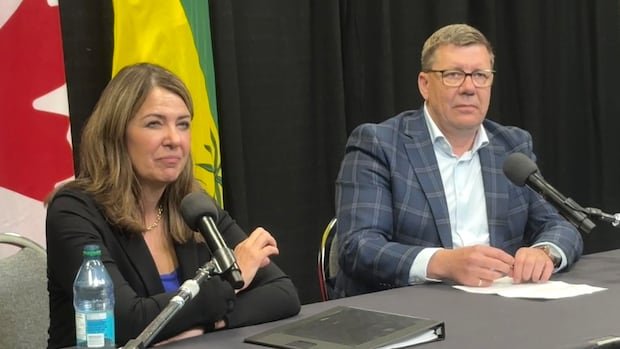

Premier Scott Moe has expressed his backing for Alberta’s newest pipeline initiative, stressing that the decision should not be subject to veto by any external group other than the federal government.
In response to concerns raised by B.C. Premier David Eby and various B.C. Indigenous groups regarding the proposed project, Moe emphasized the collective ownership of Canada’s coast and ports, stating, “There is no B.C. coast. It’s Canada’s coast. There are no B.C. ports. There are Canada’s ports.” He highlighted the importance of diversifying the country’s economy away from the U.S. and asserted that no other project could achieve this goal as effectively as the proposed pipeline.
Alberta Premier Danielle Smith recently unveiled plans to develop and submit an application to the federal Major Projects Office for a new pipeline designed to transport bitumen from Alberta to the northwest coast of British Columbia. Under this initiative, Alberta intends to allocate $14 million towards the project and lead a “technical advisory group,” which will involve pipeline companies such as Enbridge, South Bow, and Trans Mountain. The province aims to identify a private company or consortium to undertake the pipeline construction, with a specific route yet to be proposed. The application submission is anticipated in the spring of 2026.
Following Alberta’s announcement, reactions from across the country varied, with B.C. Premier David Eby criticizing the project for its reliance on government support and lack of a private sector proponent. Federal Conservative Leader Pierre Poilievre expressed support for the pipeline, advocating for private investors to take the lead due to the project’s profitability. However, several Indigenous leaders in B.C., including Marilyn Slett of the Coastal First Nations-Great Bear Initiative and the Heiltsuk Tribal Council, opposed the project, citing concerns about lifting the moratorium on oil tankers along the northern B.C. coast.
Despite opposition from B.C. groups and leaders, Premier Moe rejected the notion of granting veto power to them over the project, emphasizing the importance of consulting Indigenous communities. He highlighted the upcoming duty to consult process and the potential benefits for all stakeholders through investments like the proposed pipeline.
Looking ahead, Prime Minister Mark Carney recently announced a series of “nation-building” projects to be expedited by the federal government, including Saskatchewan’s McIlvenna Bay Foran Copper Mine Project. This project, nearing completion near Creighton, is set to commence operations in 2026, providing significant employment opportunities. Federal Minister for Energy and Resources Tim Hodgson hinted at additional project announcements on the horizon, with Premier Moe mentioning interest in various mining ventures, particularly emphasizing a “port-to-port” pipeline corridor connecting Prince Rupert in B.C. with Churchill, Man., as a key project of interest.
The push for diverse economic initiatives and infrastructure development remains a focal point in the ongoing discourse surrounding Alberta’s pipeline proposal and future projects across Canada.