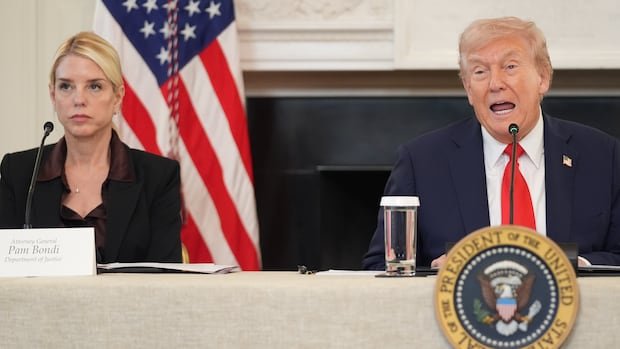

U.S. President Donald Trump is making efforts to convince the American public that the anti-fascist movement known as Antifa represents a serious threat to the nation, comparable to designated terrorist groups like Hezbollah. Trump, along with key law enforcement officials and a select group of conservative journalists, dedicated over an hour during a White House event to portray Antifa as highly violent, well-funded, and committed to undermining American democracy.
This push is viewed as part of the administration’s ongoing strategy to justify potential deployment of troops into cities led by Democratic officials, such as Chicago and Portland, Oregon, which Trump frequently characterizes as chaotic war zones. At a televised roundtable discussion, Homeland Security Secretary Kristi Noem likened Antifa to criminal gangs in Venezuela and militant factions in the Middle East, emphasizing their perceived level of sophistication and danger.
Despite lacking concrete evidence or intelligence suggesting that Antifa possesses the resources, capabilities, or intentions to execute large-scale attacks akin to established terrorist organizations, Noem drew parallels between Antifa and groups like MS-13, ISIS, Hezbollah, and Hamas. Antifa, described as a global decentralized movement without centralized leadership, considers its mission as safeguarding society against neo-Nazi and white supremacist ideologies.
Contrary to this characterization, Trump and his team portrayed Antifa and other left-wing extremists as actively engaging in a “campaign of violence” against Immigration and Customs Enforcement (ICE) personnel. FBI director Kash Patel asserted that Antifa poses a threat to ordinary citizens across various communities and vowed to target the movement by following its financial trail to dismantle it.
Critics, including terrorism expert David Schanzer, believe that the administration’s depiction of Antifa is primarily aimed at justifying a wider crackdown on progressive protests. Schanzer challenged the authorities to provide evidence of the alleged threat posed by Antifa and emphasized the need for transparency in any actions taken against the movement.
In September, Trump signed an order designating Antifa as a domestic terrorist organization, a move that legal analysts find ambiguous in terms of practical implications. While federal law enforcement agencies already possess the authority to investigate violent groups, Attorney General Pam Bondi suggested framing the crackdown on anti-ICE demonstrations as a response to anarchy rather than lawful activism.
During the roundtable, conservative social media influencers shared personal experiences of encountering violence from Antifa members and urged the administration to take decisive action. The focus was particularly on Portland, where Trump sought to deploy National Guard troops, a move currently halted by legal challenges.
Secretary Noem’s visit to the ICE facility in Portland, described by Trump as besieged by Antifa, revealed a scene of demonstrators with signs, including an individual clad in a chicken costume. This narrative, promoted by the administration, continues to fuel debates surrounding the characterization and handling of Antifa within the U.S. context.