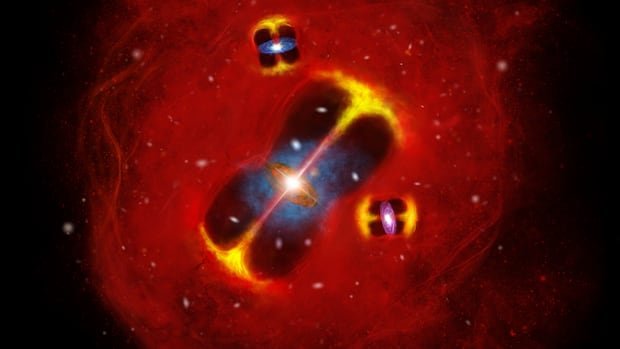

A group of international scientists, led by an astrophysicist from the University of British Columbia, has identified a young galaxy cluster generating hot gas at a rate five times higher than previously believed possible. This groundbreaking finding has garnered excitement among astrophysicists, potentially altering perspectives on the universe’s early evolution post-Big Bang.
Published in the prestigious Nature journal, the study involved over two dozen researchers worldwide who focused on the galaxy cluster SPT2349-56 situated approximately 12 billion light years away. The team, spearheaded by UBC’s PhD candidate Dazhi Zhou, observed a substantial production of hot gas in the intergalactic space.
Zhou noted that this detection of intensely hot gas at an early cosmic stage is unprecedented. The galaxy cluster in question is relatively “young,” forming a mere 1.4 billion years after the Big Bang. This discovery represents a significant leap in understanding the universe’s mechanisms, as expressed by Zhou during an interview with CBC News.
James Di Francesco, director of the Dominion Astrophysical Observatory near Victoria, emphasized that previous theories did not anticipate galaxy clusters reaching such high temperatures so quickly. Typically, the gas surrounding galaxies is expected to heat up gradually over time due to energy injection from the galaxies’ orbital movements.
The sudden and dramatic heating of gas within this nascent cluster challenges conventional expectations, providing a fresh perspective on cluster evolution. This novel insight into the early universe offers a unique opportunity to study the formation processes of these cosmic structures.
The researchers utilized various telescopes in Chile to uncover this phenomenon, enabling them to delve into star formation and explore the universe’s primordial era. By employing radio telescopes operating in submillimeter and millimeter wavelengths, the team precisely measured the gas’s temperature despite its immense distance from Earth.
Zhou highlighted the importance of this research in elucidating the origins and development of contemporary massive galaxy clusters. Galaxy clusters comprise collections of galaxies, ranging from hundreds to thousands, with our own Milky Way belonging to the Virgo supercluster, potentially housing over 2,000 galaxies.
The implications of this study are far-reaching, shedding light on the intricate processes shaping our cosmic landscape and unraveling mysteries of the universe’s early history.