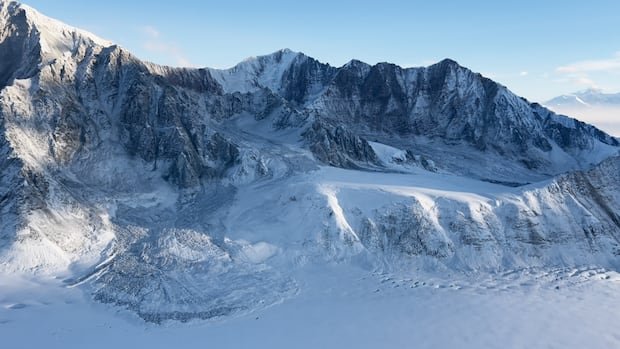

A team of researchers from the Yukon Geological Survey is currently conducting aerial surveys in a remote mountainous region in southwest Yukon to investigate the aftermath of a magnitude 7.0 earthquake that shook the area in December. This seismic event near the Alaska-Yukon border has provided evidence for a previously hypothesized fault hidden beneath the earth’s surface, confirming the long-standing theory.
The intersection of two major plate boundary systems in the southwestern corner of the Yukon has puzzled experts like Michael West, Alaska’s state seismologist and research professor at the Alaska Earthquake Center. This unique geological setting, where significant plate tectonics converge, has been described as the ‘train wreck of plate tectonics’ due to the limited understanding of its dynamics.
While both Alaska and the Yukon are known for their seismic activity, the recent earthquake occurred in an area that historically experienced minimal seismic events. Researchers have long speculated about a possible link between the North American plate boundary and substantial faults within the plate’s interior, a hypothesis now substantiated by the earthquake.
The earthquake, which occurred on December 6 at 12:41 p.m. local time, was most strongly felt in the communities of Burwash Landing and Haines Junction, with tremors reaching as far as Whitehorse, approximately 250 kilometers away. Residents, like Pascale Dubois from Burwash Landing, recounted experiencing intense shaking and fearing for their safety during the earthquake.
Despite the earthquake’s magnitude, its impact on the Yukon population was relatively minor, with only a few incidents of items falling off shelves. Michael West emphasized the significant power of a magnitude-7 earthquake, noting that in other regions, such an event could result in significant casualties.
The aftermath of the earthquake is visible in Yukon’s Kluane National Park, where researchers have been conducting field reconnaissance to study the fault line and its effects on the landscape. The ongoing seismic activity following the earthquake is expected to provide valuable insights into the mountain-building processes in the region, shedding light on plate deformation mechanisms.
The research interest surrounding the earthquake event has attracted global attention, with experts worldwide investigating the seismic event from various perspectives. By mapping the fault lines beneath the surface, researchers aim to enhance understanding of earthquake occurrences in the region and assess potential risks to nearby communities.