
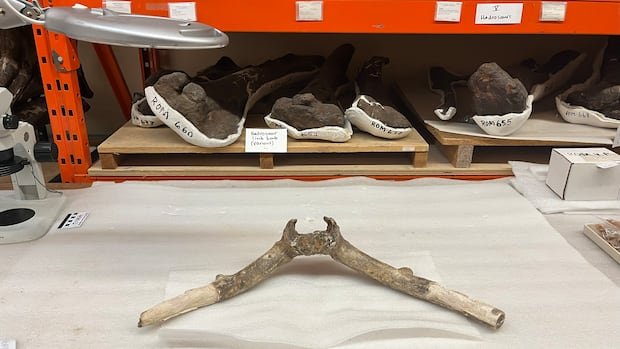

For almost five decades, a mysterious fossil discovered during the construction of Islington subway station has remained enigmatic until now. Researchers from Trent University, in collaboration with the Royal Ontario Museum and the Royal Alberta Museum, have established a connection between the fossil and two deer species prevalent in North America.
According to Aaron Schafer, an associate professor at Trent University involved in the study, after thorough analysis, it was determined that the fossil is closely related to whitetail and mule deer but represents a distinct species that diverged approximately 3,000,000 years ago. The fossil, known as “Torontoceros hypogaeus” or the “horned Toronto deer from underground,” is estimated to be around 12,000 years old and is considered a unique specimen shedding light on the past environment.
Oliver Haddrath, a collections technician at the Royal Ontario Museum, remarked that the fossil appears to have thrived in a more expansive, tundra-like habitat compared to the forested areas of recent centuries, indicating a significant adaptation for open spaces.
Looking ahead, Schafer expressed interest in delving deeper into the factors contributing to the species’ extinction, suggesting climate influences and genetic issues within a dwindling population as potential causes.
Although the fossil has been in the possession of the ROM since its discovery, technological limitations hindered the identification process. With advancements in DNA analysis, Haddrath emphasized the breakthrough in answering previously unanswerable questions and placing ancient samples into their genealogical context.
The ROM’s fossil gallery, currently undergoing renovation, will soon showcase the intriguing “Torontoceros hypogaeus” for public viewing, offering a glimpse into the past life of this unique deer species.