
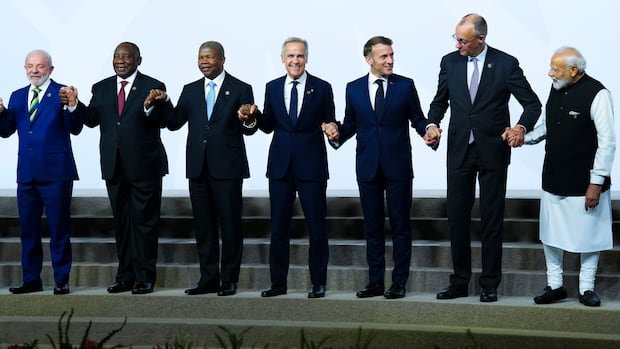

Leaders gathered at the G20 summit in South Africa raised concerns about the group’s significance and effectiveness due to increasing geopolitical tensions and a shifting global landscape. Established in the late 1990s, the Group of 20, initiated partly by former prime minister Paul Martin, has convened annually since 2008, focusing on global economic and financial stability.
The concept of multilateralism, where nations collaborate and coordinate for mutual benefit, is at the core of the G20’s mission. However, significant changes have occurred over the past two decades. French President Emmanuel Macron highlighted the challenges faced in resolving major crises collectively, suggesting that the G20 might be nearing the end of its current phase.
The evolving global order, as described by Prime Minister Mark Carney, is experiencing a “rupture,” primarily influenced by the United States and President Donald Trump. Trump’s trade disputes with various nations and his transactional approach to conflicts like the Ukrainian war have shifted the focus of G20 members towards economic security rather than unity.
Even China, a major economy often criticized for destabilizing global security, expressed apprehensions about the future. Chinese Premier Li Qiang noted the prevalence of unilateralism and protectionism, prompting reflections on the state of global solidarity. Finland’s President Alexander Stubb, attending the G20 for the first time, also voiced concerns about the fate of multilateralism, emphasizing a shift towards deal-making that could lead to conflicts.
Despite the absence of U.S. officials, a move reflecting America’s “America First” policy, the remaining nations at the summit displayed solidarity. Foreign Affairs Minister Anita Anand highlighted the adoption of a consensus declaration at the summit’s outset, underscoring the value of formal and informal discussions among leaders for advancing multilateralism.
In response to the Ukrainian crisis, a coalition of countries including Canada, the U.K., Japan, France, Germany, and the EU addressed the challenges faced by Ukraine. They cautiously welcomed U.S. peace efforts while emphasizing the need for further refinement of the proposed plan to ensure stability in the region.
The G20 summit also served as a platform for countries like Canada to seek new partnerships for trade and security amid evolving global dynamics. Prime Minister Carney emphasized the importance of building a new framework for cooperation and announced significant investment deals and trade negotiations with various nations, including the U.A.E., South Africa, and India.
Looking ahead, the G20’s future appears promising with upcoming presidencies held by the U.S., the U.K., and South Korea. While global cooperation advocates acknowledge the changing landscape of multilateralism, they believe there are opportunities for middle powers like Canada to play pivotal roles in shaping inclusive and effective global arrangements.