
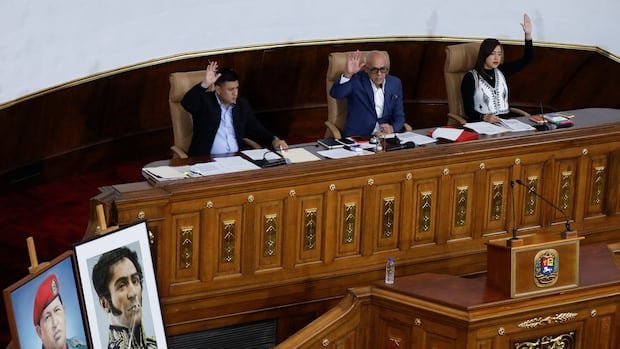

Venezuela’s national assembly has passed a new law aimed at criminalizing various activities that could impede navigation and trade within the country, such as the seizure of oil tankers. The bill was swiftly introduced, debated, and approved in the National Assembly, following recent seizures of Venezuelan oil-carrying vessels by U.S. forces in international waters.
The seizures are part of a broader strategy employed by U.S. President Donald Trump in his ongoing pressure campaign against Venezuela’s President Nicolás Maduro. The U.S. administration claims that the tankers targeted are part of a fleet used by Venezuela to circumvent economic sanctions imposed by the United States.
The legislation, which is under the control of Venezuela’s ruling party, includes severe penalties of up to 20 years in prison and fines for individuals involved in activities deemed as piracy, blockades, or other illegal acts against commercial entities operating in Venezuela. Notably, the bill also mandates the executive branch to develop measures to protect national or foreign companies conducting business with Venezuela in the event of piracy-related incidents or unlawful blockades.
The U.S. Coast Guard recently intercepted two vessels, including the Panama-flagged Centuries and the rogue tanker Skipper, both linked to moving sanctioned cargo. Following these incidents, President Trump announced intentions to enforce a “blockade” against Venezuela and demanded the return of assets seized from U.S. oil companies by Venezuela in the past.
At a United Nations Security Council meeting initiated by Venezuela, the U.S. Ambassador emphasized that oil tankers under sanctions are crucial for Maduro’s regime and its financial operations. The U.S. reiterated its commitment to imposing stringent sanctions to hinder Maduro’s access to resources supporting his government and alleged criminal activities.
Venezuela’s UN Ambassador accused the U.S. of violating international and domestic laws by seizing Venezuelan oil and imposing a naval blockade, stating that such actions could destabilize the country and pave the way for external intervention. Several countries expressed concerns over potential breaches of international maritime laws, emphasizing the importance of upholding the UN Charter’s principles of respecting the sovereignty of all nations.
The bill is now awaiting Maduro’s signature, signaling a further escalation in the ongoing tensions between Venezuela and the United States over economic sanctions and control of oil resources.