
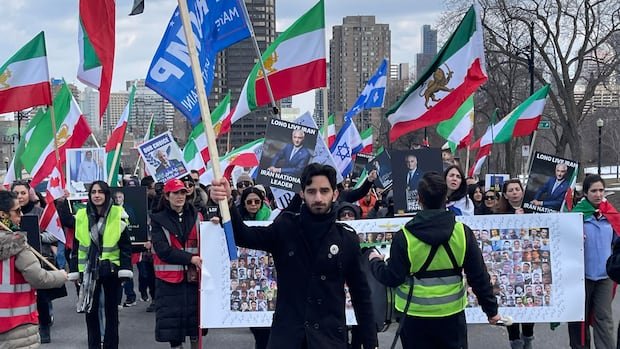

Following the U.S. and Israel’s attack that led to the death of Iran’s Supreme Leader Ayatollah Ali Khamenei on February 28, numerous Iranian Quebecers celebrated in the streets. Over six weeks later, the ongoing conflict involving the U.S., Israel, and Iran is eliciting varied reactions from the diaspora.
Atena Barforoushi, an Iranian resident of Montreal, expressed relief upon hearing about the recent two-week ceasefire. While she was never in favor of the war, she found satisfaction in Khamenei’s demise. However, she now questions the aftermath, noting that the regime appears to have strengthened following the leader’s death.
While some experts suggest that Iran holds the advantage due to enhanced control of the Strait of Hormuz since the conflict’s onset, Khashayar Hoseinzad disagrees, arguing that the U.S. and Israel have effectively weakened the regime’s forces.
Hoseinzad, a 26-year-old Montrealer who left Iran at 17, remains skeptical of the ceasefire’s impact on negotiations. His prediction seems to align with the outcome of the recent talks, indicating little progress in that regard.
Concerns about the ceasefire’s implications are shared by Maryam Dayani, a 33-year-old Montreal resident. She believes that during a ceasefire, Iran tends to divert resources towards rebuilding missile infrastructure and advancing its nuclear program, potentially leading to dire consequences.
Dayani’s worries extend to the possibility of increased executions by the Iranian regime during the ceasefire period. The prolonged internet blackout in Iran, now in its 45th day, has hindered communication with her family, raising further concerns.
According to Iranian political expert Vahid Yucesoy, the ceasefire poses genuine risks to Iranians’ safety, emphasizing that the regime’s primary conflict is with its own people. The expert underscores the regime’s fear of internal resistance more than external threats.
The largest display of dissent against Iran’s regime began with nationwide protests in late December, evolving into demands for economic reforms and an end to the repressive theocracy. The violent crackdown on protesters resulted in casualties, including Hoseinzad’s cousin.
Hoseinzad has been actively participating in Montreal rallies to advocate for change and raise awareness about the situation in Iran. The demonstrations feature symbols of resistance, such as Iran’s historic lion and sun flag, representing opposition to the current regime.
Despite varying opinions within the Iranian diaspora, political analysts like James Devine observe a divided community with differing stances on the conflict and foreign intervention. Devine highlights the absence of a unified political opposition within Iran and notes a shift in public support towards the official state flag.
The controversial statements made by U.S. President Donald Trump, threatening severe actions against Iran, have sparked fear and uncertainty among Iranians worldwide. While some in the diaspora continue to support Trump, others express concern over the potential consequences of his rhetoric.
Overall, the Iranian diaspora remains divided on issues surrounding the conflict, with individuals like Hoseinzad believing that ultimately, the Iranian people will play a pivotal role in determining the regime’s fate.