
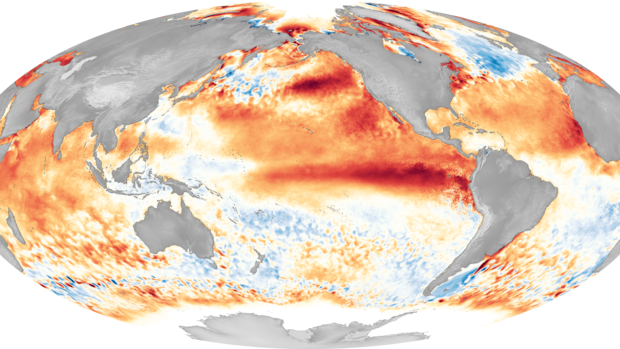

In the realm of weather predictions, there has been considerable discussion about the potential emergence of an intense El Niño phenomenon in the near future. This occurrence is projected to elevate the global temperature and intensify extreme weather patterns.
Various climate models are indicating a robust El Niño event on the horizon, expected to initiate around June or July and reach its peak in November. Some models suggest that ocean temperatures in a critical Pacific region could soar up to 2 degrees Celsius above the norm, with certain projections forecasting even higher anomalies.
El Niño is a component of the broader El Niño-Southern Oscillation (ENSO) system, which exerts influence on weather phenomena worldwide. When ocean temperatures in the specific Niño 3.4 region of the Pacific Ocean rise above average levels, it signals the onset of an El Niño event. Conversely, cooler temperatures lead to a La Niña phase, with a neutral phase also existing within this system.
The U.S. National Oceanic and Atmospheric Administration (NOAA) recently issued its monthly ENSO update, indicating an 82% likelihood of El Niño formation between May and July and a 96% probability of its continuation from December to February. Despite these predictions, there remains uncertainty regarding the potential peak intensity of the upcoming El Niño.

Under normal circumstances, trade winds blow westward along the Pacific equator, transferring warm water from South America towards Asia. This movement results in the upwelling of cold water from the ocean depths to replace the warm water.
During an El Niño event, this process undergoes a reversal as the trade winds diminish, leading to the current formation of such conditions.
While the possibility of a strong or potentially ‘super’ El Niño taking shape this year is being considered, experts suggest that Canada may not experience significant impacts during the upcoming summer season. Nonetheless, the repercussions of a potent El Niño are expected to reverberate globally.
The positive news for Canada is that the immediate effects are unlikely to be felt this summer.
Winter Outlook
The forecast points to the development of El Niño around June or July, peaking approximately in November or December.
Typically, these are the months when Canadians might anticipate the effects of El Niño to manifest.
“The most significant impacts in Canada tend to occur during the winter months, particularly in Eastern and Central Canada, where winters tend to be notably milder,” as stated by Kent Moore, an atmospheric physics professor at the University of Toronto.
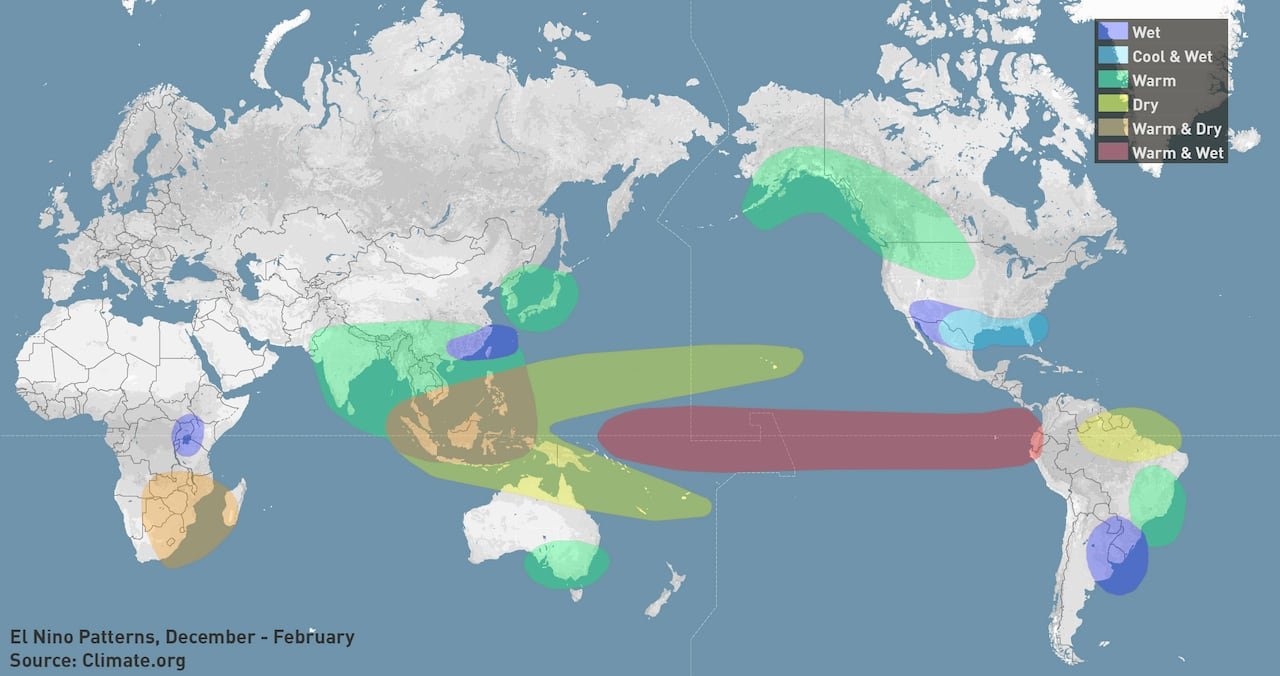
Moreover, the warmth associated with El Niño is not limited to Eastern Canada but extends to the Western regions as well.
In the last notable El Niño episode, Canada witnessed its warmest winter on record in 2023-2024, with a temperature anomaly of 1.5 degrees Celsius in the Pacific Ocean’s El Niño 3.4 region. Forecasts suggest that the upcoming El Niño could register anomalies closer to