
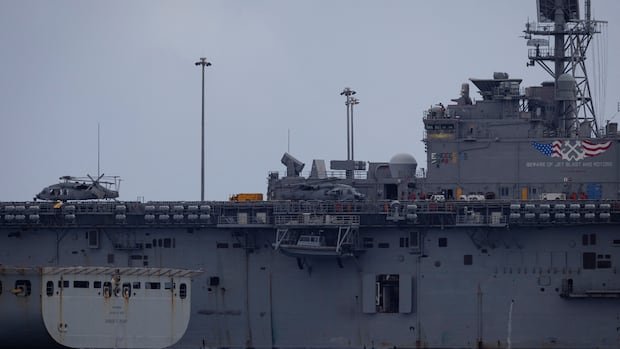

The head of the Royal Canadian Navy is suggesting the potential development of an ice-capable amphibious landing vessel to transport troops and equipment in the Arctic region and beyond. Vice-Admiral Angus Topshee has cautiously approached the idea, referring to it as a conceptual exercise during various discussions. This concept has been preliminarily discussed between naval strategists and two Canadian shipyards – Davie Shipyard in Lévis, Que., and Seaspan in Vancouver – both involved in constructing the Canadian Coast Guard’s new icebreaker fleet.
Topshee mentioned that the shipbuilders have proposed the theoretical feasibility of a Polar Class 2 amphibious vessel. Such a vessel could transport smaller landing craft, like hovercraft, and helicopters to deliver capabilities from sea to shore without the need for established port infrastructure, particularly suitable for the challenging Arctic environment.
With an anticipated new defense policy expected from the federal Liberal government in 2026, the concept of an ice-capable landing ship could influence the upcoming defense policy review. Canada has committed to increasing its defense spending to approximately five percent of its GDP annually, allowing military leaders the flexibility to consider ambitious projects that were previously unattainable.
Topshee has also advocated for a new class of corvettes in addition to the existing fleet of vessels. However, the focus remains on the ice-capable landing ship as a potentially crucial asset for showcasing Canadian sovereignty in the Arctic. The ability to swiftly move troops and equipment, whether in the Arctic or elsewhere, has been a longstanding concern for the military.
The idea of acquiring an amphibious support or assault ship has been discussed in Canada for over two decades, with intermittent progress due to fiscal and institutional challenges. Other countries, such as Australia and Japan, have integrated amphibious ships into their national security strategies, emphasizing their importance for regional leadership and disaster response.
In a changing landscape where allies are adapting their naval capabilities, the potential development of an ice-capable amphibious landing ship could signify a significant step for Canada in strengthening its military presence in the Arctic region and beyond.