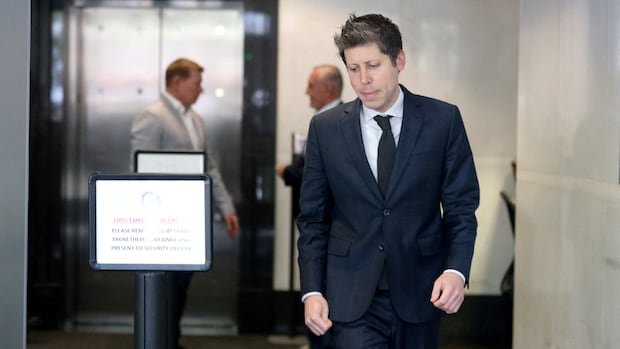

In a high-stakes legal battle, two billionaires are at odds, with Elon Musk, the wealthiest individual globally, accusing OpenAI CEO Sam Altman of “stealing” a charitable organization. Musk is seeking Altman’s removal from the company’s leadership, alleging that OpenAI violated its founding agreement by transitioning to a for-profit entity. The case, seeking $150 billion in damages, concluded with closing arguments in Oakland, California, and awaits a jury decision overseen by U.S. District Judge Yvonne Gonzalez Rogers.
Ebrahim Bagheri, a specialist in responsible AI development at the University of Toronto, emphasizes the significant implications the court’s ruling will have on the AI market. Bagheri highlights the unforeseen growth and profitability of generative AI technology since OpenAI’s inception, stressing that any restructuring within OpenAI could reshape not only the services provided by the company but also those of numerous other industry players like Microsoft.
The trial witnessed a procession of affluent Silicon Valley personalities testifying, while demonstrators outside the courthouse criticized both parties. Catherine Bracy, CEO of TechEquity, noted a sentiment among the general public wishing for a resolution where neither side emerges victorious, portraying the controversy as a situation where “everyone sucks.”
The core dispute revolves around OpenAI’s transformation from a non-profit organization, co-founded by Musk and Altman in 2015, to a for-profit entity slated for a $1 trillion valuation in its upcoming public offering. Musk contends that Altman and OpenAI’s president, Greg Brockman, misled him into providing financial support, ultimately leading to OpenAI’s shift to a for-profit model. Musk also accuses OpenAI of receiving substantial investments from companies like Microsoft. The case unveiled internal emails showcasing a strained relationship between Musk and Altman, with Musk emphasizing the monumental consequences at stake for civilization.
During the trial, Musk repeatedly characterized OpenAI as a charity, despite its initial non-profit status. He recounted a conversation with Google’s Larry Page, wherein Page’s indifferent view towards AI’s impact on humanity motivated Musk to champion an open-source non-profit AI initiative. Musk’s warnings about the existential risks associated with AI technologies were met with restrictions from the judge, who cautioned against invoking references to dystopian sci-fi scenarios like “The Terminator.”
Altman’s leadership ethics came under scrutiny, exacerbated by a recent critical profile in The New Yorker. Altman defended his integrity under cross-examination, asserting his honesty in business dealings. Musk’s absence during closing arguments, as he accompanied President Trump on a diplomatic trip to China, further fueled the courtroom drama. The legal teams sparred over allegations of dishonesty and conflicting visions for OpenAI’s future, with accusations of arrogance and deceit exchanged between the opposing sides.
As the trial nears its conclusion, observers anticipate a ruling early in the week, underscoring the broader themes of power dynamics and accountability in a narrative where billionaire clashes dominate the legal discourse. The outcome of the case is poised to shape the landscape of AI development and governance, reflecting the complexities of tech industry power struggles.