
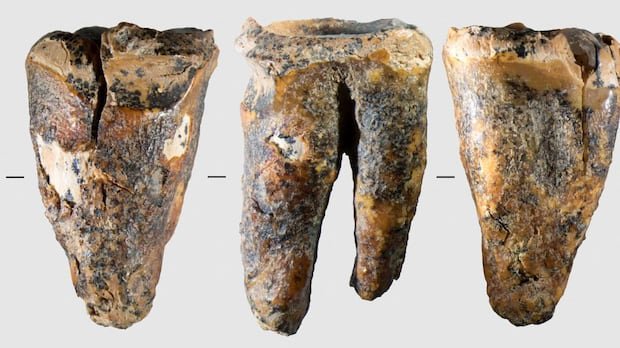


Around 59,000 years ago, a Neanderthal residing in the Siberian mountains dealt with a severe toothache and took action to alleviate the pain.
New research reveals that a lower molar found in a cave near the Altai Mountains exhibited signs of dental work – a large hole that seemed to have been manually drilled using a stone tool to remove decay.
As detailed in a publication in the journal PLOS One, this marks the earliest known instance of invasive dental surgery, occurring many millennia before recorded evidence of Homo sapiens addressing cavities, indicating that the extinct archaic human species possessed more sophistication than previously acknowledged.
The Neanderthal Dental Dilemma
Anthropologist John Olsen, a study co-author, discusses the potential scenarios for how a Neanderthal with a tooth infection might have sought treatment. He suggests that either the individual sought external help due to intense pain or attempted a self-administered remedy using a stone drill, with the former being more plausible given the social nature of Neanderthals.
Olsen dismisses the idea of specialized Neanderthal dentists but speculates that a proficient medical practitioner may have performed the procedure due to the meticulous nature of the dental intervention.
Insight into Neanderthal Abilities
The tooth belonged to an unidentified adult and was excavated at Chagyrskaya Cave in Russia, a site rich in Neanderthal fossils. Researchers closely examined the fossil and concluded that the intentional modification, indicated by markings and hole shape, was not accidental damage.
To validate their findings, experiments on modern human teeth replicated the same hole shape and microscopic grooves by using a stone tool similar to those found at Chagyrskaya Cave.
Prior to this discovery, the oldest evidence of dental surgery was a Homo sapiens tooth from Italy dating back approximately 14,000 years, displaying cavity treatment through scraping with a stone tool.
The study’s senior author, Kseniya Kolobova, from the Russian Academy of Sciences, highlights the cognitive sophistication of Neanderthals, emphasizing the deliberate planning, motor skills, and medical strategy involved in the dental procedure.
Historical Medical Insights
Mark Collard, a Simon Fraser University archaeologist not involved in the study, acknowledges the significance of this early instance of healthcare provision among Neanderthals, noting the challenge in definitively classifying it as a dental procedure.
Neanderthals, who coexisted with Homo sapiens until their extinction approximately 40,000 years ago, have been subject to various depictions in popular culture, but recent research dispels misconceptions about their intelligence and capabilities.
John Olsen emphasizes the remarkable communication skills required to convey the benefits of enduring pain for long-term relief during the dental procedure, highlighting the complexity of Neanderthals’ societal interactions beyond stereotypical portrayals.