
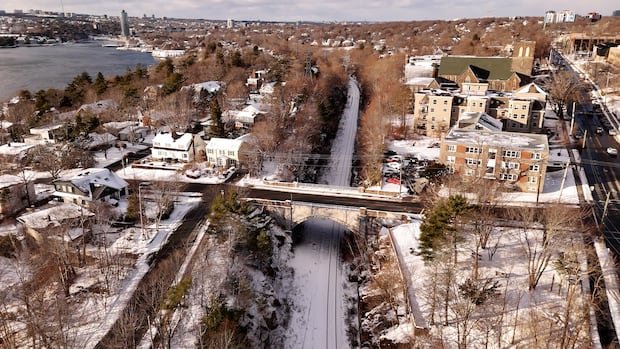

Travelers in Halifax might find themselves confused by the unconventional paths of some of the city’s main roads.
For locals, dealing with the abrupt road closures and traffic jams has become a daily annoyance during their commute.
The unique road layout of the peninsula was not the result of careful city planning, but rather a massive and disruptive engineering project that took place over a hundred years ago.
Historian Bob Chaulk delved into the story of the Halifax rail cut, a project that reshaped the city’s landscape significantly. Chaulk’s recent book, Railroaded: The Untold History of Halifax’s Rail Cut, delves into the turbulent history of this endeavor.
“The rail cut that slices through the peninsula, with its 15 bridges that drivers must cross, hasn’t just complicated traffic flow, it has disrupted it,” he remarked.
The rail cut was essentially a trench carved through the peninsula to link trains to a new port, resulting in a restructuring of the city’s road network.
This transformation accounts for the oddities like Connaught Avenue abruptly ending at Jubilee Road and Robie Street fading into a wooded area.

The origin of the rail cut dates back to a critical period in Halifax’s history.
Originally established as a British naval base in 1749, Halifax faced an uncertain future when the Royal Navy announced its withdrawal in 1904.
Being the economic backbone of the city, the military presence had a significant impact.
By 1907, the Royal Naval Dockyard was officially handed over to the Canadian government.
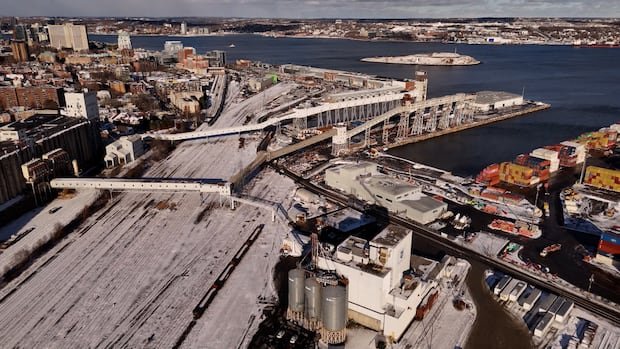
Halifax’s peculiar road layout is not because of confused urban planners, but the result of a massive and disruptive engineering project from a century ago. That’s when a new rail line was put in from one end of the peninsula to the other. The CBC’s Vernon Ramesar reports.
“Essentially, Halifax’s primary reason for existence ceased,” Chaulk stated.
“The logical step was to transform into a commercial port, necessitating substantial investments in railway infrastructure, wharfs, and docks.”
The board of trade’s answer was to redesign Halifax as a major commercial harbor.
This involved establishing a direct railway line to modern deepwater docks, bypassing the old, inefficient route that terminated near Duffus Street, far from the docks.