
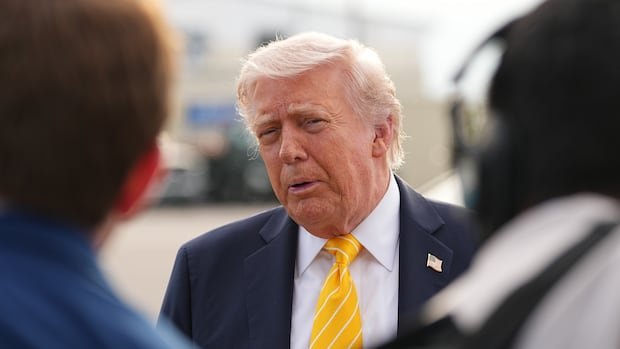

U.S. President Donald Trump announced on Saturday that he is currently assessing a new proposal from Iran to bring an end to the ongoing conflict. However, he expressed doubts about the potential for reaching a final agreement. Trump mentioned that the exact details of the proposal were being provided to him and he would share further information later.
Following his interaction with reporters, Trump took to social media to express his skepticism about the viability of the new offer, citing that Iran has not faced sufficient consequences for their actions over the past 47 years. The proposal, consisting of 14 points, was reportedly transmitted through Pakistan in response to a nine-point proposal from the U.S. While two semi-official Iranian news outlets shared details, Iran’s state-run media did not cover the development.
Despite Trump’s recent rejection of a previous Iranian proposal, discussions have persisted, and a three-week ceasefire remains intact. In a move to escalate pressure, the U.S. issued a warning to shipping companies concerning potential sanctions if they engage in transactions with Iran for passage through the Strait of Hormuz.
The U.S. Office of Foreign Assets Control (OFAC) posted the alert on Friday, heightening tensions as the strategic waterway, responsible for a significant portion of global oil and gas trade, continues to be a focal point in the U.S.-Iran standoff. Iran’s closure of the strait following military actions by the U.S. and Israel has disrupted normal maritime traffic, leading to alternative routing solutions and financial charges for safe passage.
In a separate development, imprisoned Nobel Prize laureate Narges Mohammadi’s health condition is of grave concern as she remains hospitalized in Zanjan, Iran. The human rights lawyer, described as being at “very high risk,” is experiencing fluctuations in blood pressure and severe nausea. Medical authorities in Zanjan are awaiting her medical records before initiating treatment, with recommendations made for her transfer to Tehran for specialized care.
Despite challenges in securing Mohammadi’s transfer to Tehran, her family and legal team are actively pursuing avenues for her medical care. Trump’s recent dismissal of an earlier proposal to resolve the conflict with Iran has added to the existing diplomatic complexities. Negotiations continue, albeit by phone, following the cancellation of U.S. envoys’ trip to Pakistan.
Meanwhile, Iran executed two individuals convicted of espionage for Israel, further exacerbating tensions between the two nations. Yaghoub Karimpour and Nasser Bekrzadeh were hanged after the Supreme Court upheld their death sentences, with accusations of leaking sensitive information to Israeli intelligence agencies. The executions reflect Iran’s stringent stance against alleged espionage activities.
The developments in U.S.-Iran relations and the execution of alleged spies for Israel underscore the ongoing geopolitical challenges in the region. The intricate dynamics in diplomacy, security, and human rights continue to shape the narrative surrounding these global issues.