
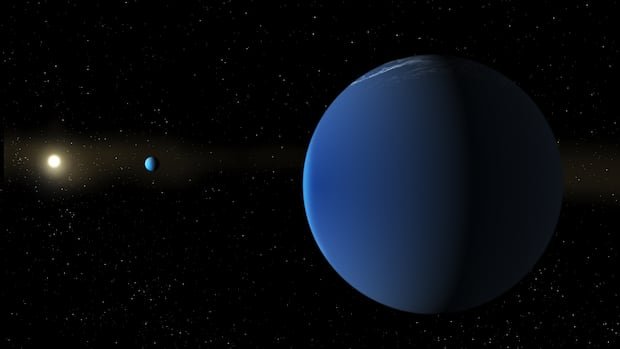


About 1,113 light years away from Earth, two planets orbiting a single star have caught the attention of astronomers due to their Jupiter-like size but incredibly low density resembling cotton candy.
These recently identified exoplanets belong to a rare class known as “super-puffs” for their remarkably low density.
Lead author George Dransfield, an astrophysicist from the University of Oxford, described them as akin to a fluffy shaving foam blob.
Exploring how such voluminous celestial bodies develop into planets larger than Earth by a factor of 1,000 remains a puzzle, as shared by co-author Antoine Petit, a mathematician from France’s Centre National de la Recherche Scientifique, during an interview with As It Happens host Nil Koksal.
Reflecting on the study published in the Monthly Notices of the Royal Astronomical Society on Thursday, Petit emphasized the need for further theoretical research to grasp the mechanisms behind the exceptional size of these planets.
Understanding Super-Puff Planets
Super-puffs are considered rare sightings in the universe, with less than 40 out of nearly 6,300 confirmed exoplanets cataloged by NASA falling into this category.
Highlighting the significance of discovering two super-puffs orbiting the same star, astrophysicist Lisa Dang from the University of Waterloo in Ontario underscored the enigmatic nature of these massive but less dense planets.
Contrary to expectations based on mass, these super-puffs challenge conventional understanding, prompting speculation about potential internal mechanisms responsible for their unique properties.
According to Nicolas Cowan, a professor at McGill University specializing in physics and planetary sciences, the existence of super-puffs may be attributed to either their youth or high temperatures affecting their size by expanding them.
Cowan suggested that the novelty of these celestial bodies, particularly their exceptional size coupled with puffiness, could disrupt existing scientific models on planetary formation and cooling processes.
The Exceptional Puffiness
Discovered by NASA’s Tess satellite, the two super-puff planets named TOI-791 b and TOI-791 c orbit a star in the Volans constellation, recognized as the flying fish.
Initial assessments indicate the planets likely consist of hydrogen and helium, pending confirmation through observations by NASA’s Webb Space Telescope to determine their chemical composition.
NASA reports that one of these planets is comparable in size to Jupiter but with only 3% of Jupiter’s mass, while the other surpasses Jupiter in size yet contains only 5.9% of its mass.
Describing them as sibling planets due to their gravitational interaction, Petit highlighted their unique bond and shared characteristics.
While further research is needed to validate mass calculations, Cowan cautioned that the study’s conclusions on size and mass could be subject to revision. However, he expressed hope that continued exploration would unveil profound insights into the evolution of planets.
<a href="https://www.cbc.ca/radio/asithapp