

In ancient times, pigeons were utilized for various tasks such as delivering messages during wars and smuggling drugs into prisons. Recently, researchers in Vancouver have engaged these birds in a new endeavor: assisting in the development of more intelligent drones.
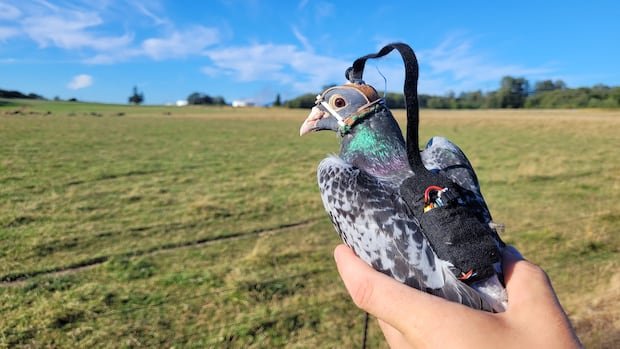
A study led by the University of British Columbia, as detailed in Current Biology, involved equipping homing pigeons with miniature backpacks containing a small computer and head-mounted cameras to observe their eye movements while flying. The entire setup weighed around 27 grams, incorporating a credit card-sized computer, a modified commercial camera, and sensors to monitor the birds’ movement and orientation.
Anthony Lapsansky, the researcher behind the project, shared that fitting the equipment onto the pigeons required meticulous effort and experimentation. Initially, fake backpacks were introduced to familiarize the birds gradually with the added weight, ensuring they remained at ease throughout the process.
During the study, approximately 16 pigeons were released along a familiar route and allowed to return to their loft, where the researchers retrieved the recorded footage after removing the equipment. The findings revealed that pigeons exhibit deliberate eye movements while in flight, potentially aiding in acquiring detailed information about their surroundings.
Contrary to previous assumptions, the research highlighted that pigeons do not keep their eyes fixed in place during flight. David Bird, a wildlife biology expert from McGill University, noted that the study challenges the notion that birds stabilize their gaze to simplify visual processing during movement.
This study’s results contrast with a recent research project from the California Institute of Technology, indicating that pigeons tend to maintain steady eye positions during flight over short distances. Bird suggested that pigeons may adjust their eye movements based on factors like altitude and potential threats.
The implications of these findings extend to the field of drone technology. By observing how pigeons use their vision to navigate, engineers may enhance drones by incorporating movable cameras to gather more comprehensive environmental data. Bird emphasized the potential benefits of integrating advanced camera systems into drones for improved functionality.
Ultimately, the study sheds light on the intricate eye movements of pigeons while flying, offering valuable insights that could influence the design and operation of future drone technology.