
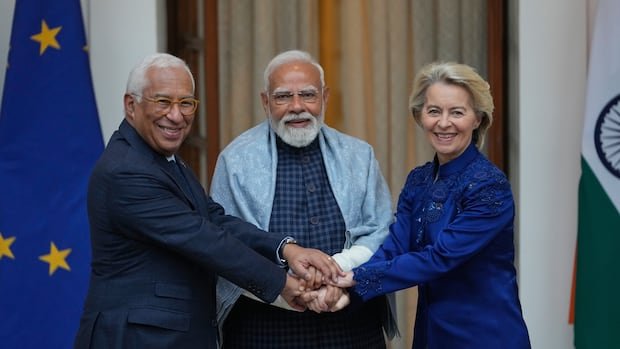

The European Union and India have unveiled an extensive trade agreement following almost 20 years of intermittent negotiations, spurred by recent tariffs imposed by U.S. President Donald Trump. Indian Prime Minister Narendra Modi and European Commission President Ursula von der Leyen hailed the deal as groundbreaking. Modi described it as India’s largest and most comprehensive trade pact, accounting for a third of global trade. The agreement significantly reduces tariffs on nearly 97% of European goods imported into India and is projected to double EU exports to India by 2032.
Von der Leyen emphasized that the deal establishes a market encompassing two billion people, highlighting the collaboration between the world’s second and fourth largest economies. The announcement coincided with India’s Republic Day celebrations, where European leaders were honored guests, underscoring the strategic importance of the agreement.
The trade deal aims to dismantle India’s longstanding trade barriers, granting access to its protected domestic market for various European products, including automobiles. Import tariffs on European cars, such as those from Volkswagen, Renault, and Mercedes-Benz, will be slashed to 10%, down from the current levels reaching as high as 110% on certain vehicles. India will reciprocate by reducing duties on European goods like wine, chocolates, and olive oil.
Furthermore, the agreement promises simplified entry for Indian skilled professionals to work in Europe, a significant advantage for India’s workforce. Von der Leyen viewed the deal as a response to global challenges, emphasizing the reduction of strategic dependencies in an era where trade is weaponized.
The negotiations were accelerated in response to the unpredictable trade policies of the Trump administration, particularly the hefty tariffs imposed on Indian exports to the U.S. last year. The EU also faced tariff threats, with a group of European nations opposing Trump’s ambitions, which led to intensified discussions with India. The deal excludes sensitive sectors like agriculture and dairy, signaling a mutual eagerness to swiftly finalize the agreement.
The formal signing of the agreement is expected later this year, with implementation likely by early 2027 after thorough legal scrutiny. The deal signifies India’s commitment to diversifying its trade relations and reducing dependence on any single dominant player in the global market.