
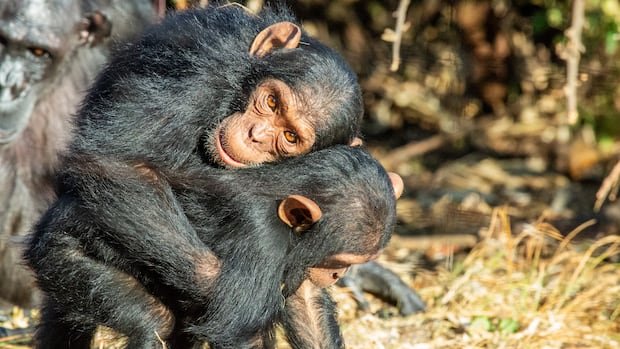

A recent study reveals how great apes, including chimpanzees and bonobos, use physical affection such as hugs, kisses, pats, and even love bites to maintain social tolerance and avoid conflicts. Lead researcher Jake Brooker explained that these gestures, including genital touching, play a crucial role in their social dynamics. The findings, published in the journal Proceedings of the Royal Society B: Biological Sciences, highlight the importance of positive touch in building strong social bonds among these primates.
The study, conducted by researchers at Durham University in England, focused on observing semi-wild bonobos and chimpanzees in great ape sanctuaries in the Democratic Republic of Congo and Zambia. The researchers noted that the primates engaged in affectionate behaviors, especially before anticipated stressful events like encounters with outside groups or feeding times.
By analyzing the interactions before feeding, the researchers found that apes who exchanged more contact were more likely to share food peacefully, indicating a correlation between positive touch and reduced competition within the groups. This pre-established trust helped prevent conflicts over resources, allowing the apes to eat more and for longer durations.
Despite the general trend observed, one group of chimpanzees did not show a similar correlation between pre-snack cuddling and peaceful feeding, suggesting that past conflicts and group histories may influence the use of positive touch within ape communities.
The study also compared the behavior of chimpanzees and bonobos, noting that both species exhibited similar positive touching behaviors despite differing levels of aggression towards out-group individuals. Primatologist Julie Teichroeb highlighted the significance of this finding, suggesting that such behaviors might have been utilized by shared ancestors to reduce social conflict.
Notably, the study found that chimpanzees engaged in more extensive canoodling than bonobos, including higher-risk behaviors like gentle biting, particularly among males. This behavior pattern suggests that more aggressive species may require greater levels of reassurance through physical contact to foster social tolerance.
Brooker emphasized the importance of positive touch in communication and bonding, noting that societal norms sometimes discourage such interactions among humans. He suggested that deep, understanding friendships could benefit from physical contact, similar to the way great apes use affection to strengthen their social relationships.