
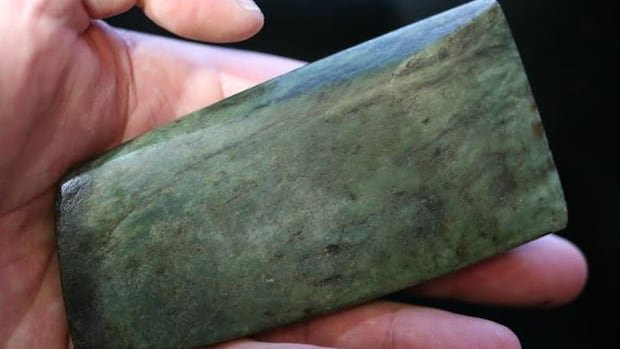

A recent study on jade artifacts discovered east of the Rocky Mountains has provided insights into the extensive Indigenous trade networks in pre-colonial Western Canada. These artifacts, crafted from nephrite jade over 3,000 years ago, were essential tools for central and coastal Salish communities in the Pacific Northwest. The stone celts, found in shades of emerald green, black, yellow, and white, were used for woodworking activities crucial for daily life.
Some of these jade tools originated in British Columbia and made their way across the Rocky Mountains to Alberta, Saskatchewan, and Manitoba. The Archaeological Survey of Alberta conducted a peer-reviewed study in collaboration with researchers from various Canadian universities. Their findings revealed that these stone celts were highly valued prestige items in the Prairies.
The study aimed to address long-standing questions in anthropology regarding the distribution of nephrite artifacts. While the use of nephrite in British Columbia was well-documented, its presence east of the Rockies was less explored. Through mineral composition analysis and origin verification techniques, researchers confirmed that each celt came from the Fraser River region in B.C.
The research proposed multiple possible trade routes for these artifacts, suggesting interactions between Interior Salish craftspeople, Dene groups, and Cree communities. The study highlighted the significant labor involved in crafting these stone celts, with smaller pieces taking over 100 hours to make. As the celts traveled further east, they transitioned from functional tools to symbolic prestige items, reflecting evolving social relationships and economic dynamics.
The study sheds light on the interconnectedness of Indigenous peoples across Western Canada, challenging the perception of pre-contact groups as isolated hunter-gatherers. By engaging with Indigenous communities and integrating traditional oral histories, researchers aim to deepen their understanding of the past and the intricate networks that shaped Indigenous cultures in the region.