
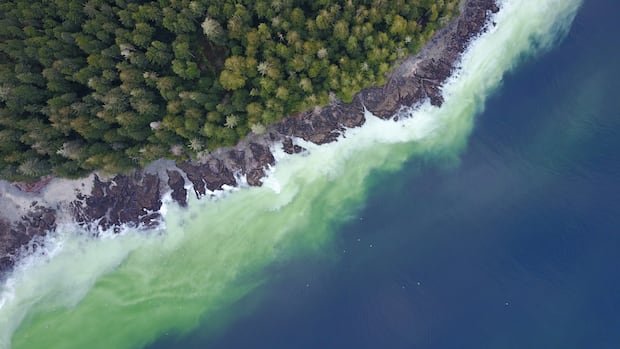

Ryan Cutler observed the ocean appearing foamy from his residence near Salmon Beach on the western side of Vancouver Island last week, signaling the start of the herring spawn. Cutler, noting the spectacle, described it as a remarkable time. Upon using his drone, he captured the distinctive foamy, milky blue-green water indicating the herring’s preparation for reproduction in the shallow coastal bays.
The herring spawn is a significant period for Vancouver Island and the South Coast, symbolizing spring and a time for food gathering for some coastal First Nations. This event also holds importance for marine conservationists as they monitor the population of these small, oily fish, which has declined due to overfishing in recent decades.
Herring, acting as a pivotal species, gather in large numbers for reproduction, with females depositing eggs on kelp and eelgrass while males release milt, giving the water a milky appearance. Cutler noticed signs of staging, where herring gather to spawn, in the weeks leading up to the event, witnessing various wildlife such as sea lions, eagles, and humpback whales converging for the feast.
Nick Chowdhury, president of the Island Marine Aquatic Working Group, emphasized the spawn’s importance for coastal First Nations, marking a seasonal shift and food-gathering opportunity. Observing the return of herring spawn to areas after a hiatus, Chowdhury highlighted the value of tracking the event through the group’s Facebook page to assess fish stocks and conservation efforts.
Shirley Louie, a seasoned fisher from the Stz’uminus First Nation, delved into learning about herring after being involved in a documentary project with the Q’ul-lhanumutsun Aquatic Resources Society. Louie’s exploration included traditional herring cleaning and preparation methods, reintroducing her to ancestral smokehouses and foods.
Engaging with the herring spawn through social media platforms like the Island Marine Aquatic Working Group’s page aids in understanding the ongoing advocacy work for stock management and fishing quotas, steering away from past practices of assuming limitless fish abundance.