
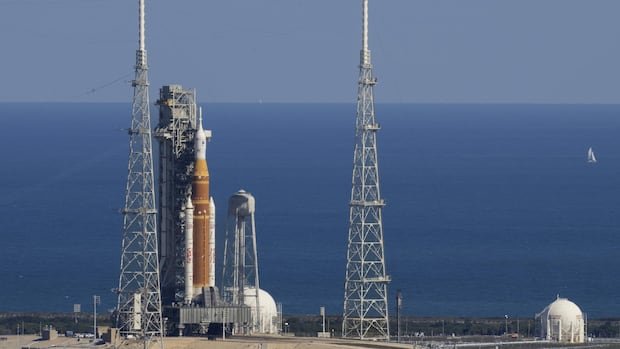

NASA encountered a leak during the fueling process of its upcoming moon rocket on Monday, a crucial test to determine the timeline for astronauts’ lunar fly-around mission. The launch team initiated the loading of the 98-meter rocket with super-cold hydrogen and oxygen at Kennedy Space Center in Florida, aiming to fill the tanks with over 2.6 million liters, simulating the final stages of a countdown. However, the operation faced a setback as excessive hydrogen was detected near the rocket’s base just a few hours after commencement, leading to a temporary halt in hydrogen loading with only half of the core stage filled.
After a brief pause, the loading process resumed but was interrupted again before finally continuing after 4 p.m. ET. To address the issue, the launch team utilized techniques developed during the previous Space Launch System (SLS) rocket launch three years ago, which also encountered hydrogen leaks before a successful lift-off.
Meanwhile, the crew, consisting of Canadian Space Agency’s Jeremy Hansen and NASA astronauts Reid Wiseman, Victor Glover, and Christina Koch, closely monitored the dress rehearsal from Houston, around 1,600 kilometers away from Kennedy Space Center. Following a period of quarantine, they awaited the outcome of the practice countdown, which will determine the timing of their historic mission, marking the first lunar voyage by a crew in over 50 years.
Due to a weather delay caused by extreme cold weather, NASA’s launch schedule fell behind by two days. The countdown clocks were set to pause half a minute before engine ignition, allowing launch controllers to address any remaining rocket issues and ensure a smooth process. If the fuelling demonstration proceeds successfully and on schedule, Commander Wiseman and the crew could depart for the moon as early as Sunday.
The mission must launch by February 11; otherwise, it will be postponed until March, as NASA’s launch opportunities are limited within each month. The intense cold has already shortened February’s launch window by two days. The upcoming nearly 10-day mission will take the astronauts on a journey around the moon’s far side, testing the capsule’s life support systems without entering lunar orbit or attempting a landing.
NASA’s Artemis program aims to establish a sustainable lunar presence, with Wiseman’s crew laying the groundwork for future moon missions by subsequent astronauts, following the Apollo program’s last manned moon landing in the 1960s and 1970s.