
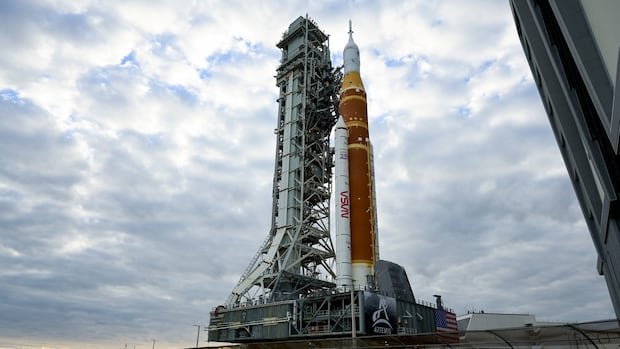

NASA’s latest moon rocket encountered an additional issue on Saturday, likely delaying astronauts’ upcoming lunar mission to the spring season. The setback was disclosed by the space agency just a day after setting March 6 as the target date for the Artemis II mission, marking humanity’s return to the moon after over 50 years. The interruption in the flow of helium to the rocket’s upper stage was identified as the cause, as this flow is crucial for engine purging and fuel tank pressurization.
This helium problem is separate from the hydrogen fuel leaks that disrupted a recent countdown rehearsal for the Space Launch System rocket. Jared Isaacman, NASA’s administrator, suggested that a faulty filter, valve, or connection plate might be responsible for the halted helium flow. The issue can only be addressed at the Vehicle Assembly Building in Cape Canaveral, Florida, requiring preparations for the rocket’s rollback and eliminating the possibility of a March launch.
Isaacman conveyed on social media that the next potential launch windows for NASA would be in early or late April. Previously, hydrogen fuel leaks had postponed the Artemis II mission, but a successful fuelling test had instilled confidence for a March liftoff. The four astronauts assigned to the mission had already entered a two-week quarantine to avoid any health risks.
The disrupted helium flow specifically affects the SLS rocket’s interim cryogenic propulsion stage, essential for positioning the Orion crew capsule into the correct orbit for testing post-launch. Following this stage, it is designed to detach from Orion and act as a docking target for crew practice in preparation for future moon missions.
While NASA’s Apollo program saw 24 astronauts travel to the moon between 1968 and 1972, the Artemis program has only completed one crewless lunar-orbiting mission in 2022. The first crewed moon landing under Artemis is still a few years away, with the program facing challenges such as fuel leaks before prior launches.