

The Olympic Games have historically been a stage for political statements, often leading to countries boycotting or facing bans due to geopolitical tensions. However, the International Olympic Committee (IOC) emphasizes that political expressions should not overshadow the sports competitions and podium ceremonies once the games commence, aiming to keep them free from external political influences.
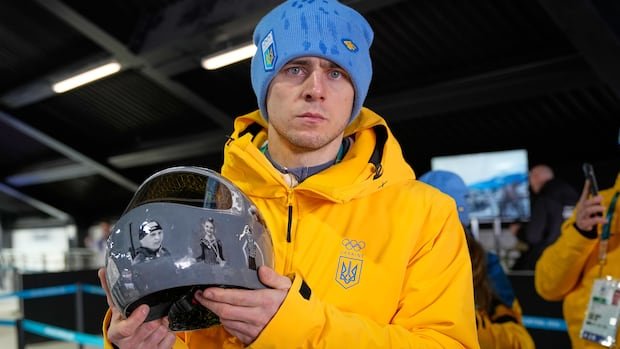
Determining what qualifies as political interference can be intricate, as seen in the recent case where Ukrainian skeleton athlete Vladyslav Heraskevych was prohibited by the IOC from wearing a helmet adorned with images of war victims. Despite the ban, IOC President Kirsty Coventry, moved by the helmet’s poignant message, acknowledged its powerful impact.
Heraskevych’s helmet depicted Ukrainian athletes killed by Russia, a nation excluded from the Olympics since its 2022 invasion of Ukraine. While his teammates protested the decision, Olympic historian Bruce Kidd noted that it aligns with a strict interpretation of the rules, acknowledging the fine line between memorializing fallen comrades and making explicit political statements.
Athletes are permitted to express political views outside of competition and ceremonies, such as through news conferences and social media. Some athletes, like certain American participants who criticized their country with anti-ICE messages, have utilized this opportunity during the current games.
Heraskevych argued that the rules were unfairly applied to him, citing precedents like Israeli athlete Jared Firestone, who wore a kippah honoring victims of the 1972 Munich attack but during the opening ceremony, not in competition. The IOC also instructed Haiti’s team to remove an image from their jackets to comply with regulations.
Enforcing these rules and defining political statements can be complex and occasionally ambiguous, according to Kidd. The prohibition on political expressions harks back to the original Olympic principles established by Baron Pierre de Coubertin in the 1890s, aiming to promote global peace and unity through sports.
Throughout history, athletes have challenged these rules, with iconic moments like the “Black Power” salute at the 1968 Mexico City Games. Despite ongoing political statements, especially in recent times, the IOC strives to maintain a balance between athletes’ freedom of expression and upholding the spirit of the games, emphasizing respect and understanding amidst global tensions and conflicts.