
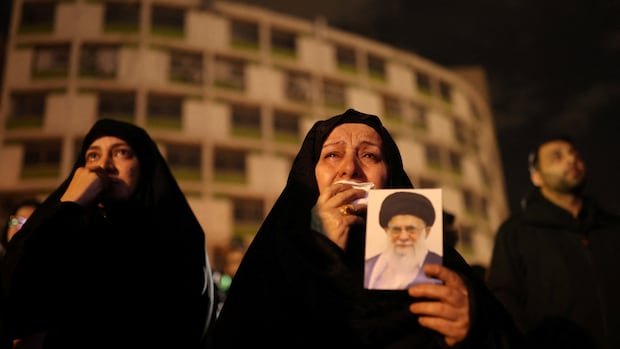

The world’s most bustling airport has closed its doors. Swarms of drones are crossing multiple borders. Millions are staying indoors, while others are grieving. Rarely has a violent incident in the Middle East had such a widespread impact across the region as swiftly as this recent episode.
Within the first 48 hours, a significant U.S.-Israeli strike deep into Iran and the subsequent assassination of its supreme leader have triggered a swift Iranian retaliation that has affected 10 Middle Eastern nations. This response has caused infrastructure damage, loss of lives, opened new conflict fronts, and hinted at a significant shift in the region’s political landscape.
Despite President Donald Trump’s assertion that Iran’s military capabilities have been greatly diminished, he has pledged to continue the lethal aerial attacks, possibly for weeks. Iran, on the other hand, has vowed more counterattacks to further escalate the situation.
Even though Iran had contingency plans for the potential loss of its supreme leader, the country’s authoritarian regime is now facing its most vulnerable state since the revolution that brought it to power nearly 50 years ago.
Following the conclusion of this conflict, Iran is likely to emerge in a weakened state, marking a transformative change in the region for generations to come.
The evolving situation will depend on Iran’s future actions towards its neighbors, Israel, and the West, as well as its internal stability and treatment of its citizens. The region could witness a surge in political repression, civil unrest, refugee crises, economic instability, and shifts in regional alliances.
The diminishing anti-American and anti-Israel sentiments could pave the way for normalized relations between Israel and other regional players. A less hostile Iran may neutralize the “axis of resistance” against Israel and the U.S., potentially reshaping the region’s political dynamics.
A weakened Iran could reduce the influence of Iran-backed militias in neighboring countries like Iraq. The killing of Ayatollah Ali Khamenei has stirred mourning among Shia Muslims, raising concerns of further unrest and regional instability.
The future behavior of a weakened Iran, its oil reserves, and the reactions of global powers like China and Russia will play crucial roles in shaping the region’s trajectory. The demise of Iran’s supreme leader is expected to prompt a shift in the country’s policies, potentially leading to diplomatic overtures with the U.S. and other changes.
The Middle East faces an uncertain future as it waits to see the aftermath of this conflict. The fate of the region’s populace, including those who have paid the ultimate price for their demands for rights, hangs in the balance.