
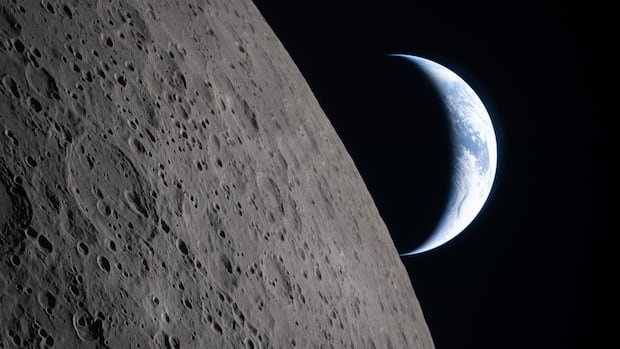

The Artemis II crew is in the process of preparing for their return to Earth following a successful orbit around the moon. Their spacecraft is now directed back towards Earth, and they are expected to splash down in the Pacific Ocean off the coast of San Diego, California, around 8:06 p.m. ET on Friday, according to NASA officials.
During a news conference on Tuesday afternoon, NASA flight director Rick Henfling mentioned the need to pack up all the scientific equipment, cameras, tablets, and reference materials that were used during the flyby. The crew is also getting ready to return home by organizing their belongings and preparing for the upcoming landing.
This historic mission set a new record on Monday for the farthest distance traveled by humans from Earth, reaching a distance of 406,771 kilometers. The previous record of 400,171 kilometers was held by the Apollo 13 mission in 1970. The crew had the opportunity to name two lunar craters, choosing the names Integrity and Carroll in honor of their capsule and astronaut Wiseman’s late wife, respectively.
The emotional moment of naming the craters was met with tears of joy in mission control, as the crew members continued their observations during the lunar flyby. They reported seeing intricate details on the moon’s surface and even glimpses of Mars, Venus, and Saturn in the distance. NASA geologist Kelsey Young highlighted the excitement in the science room when the crew spotted impact flashes caused by micro-meteorites hitting the moon.
The crew captured over 175 GB of images during the flyby, with plans to release all data and images to the public within six months. Integrity also witnessed a solar eclipse from a close distance to the moon’s surface. After the successful flyby, the crew received a call from U.S. President Donald Trump, who extended an invitation for them to visit the White House upon their return.
In a heartwarming moment, the crew engaged in a video call with the International Space Station crew, sharing experiences and discussing food preferences in space. Christina Koch, a mission specialist, reflected on how her perspective of Earth changed after seeing it from a great distance during the moon flyby. The crew expressed mutual admiration for the shared human experience of living and exploring space.
Despite the overall success of the mission, there have been ongoing challenges with the spacecraft’s toilet system. Henfling mentioned that while the toilet remains functional, there are issues with wastewater disposal. NASA’s engineering team is actively investigating the cause of the blockage, with plans for a detailed analysis upon the spacecraft’s return to the processing facility in Florida.