
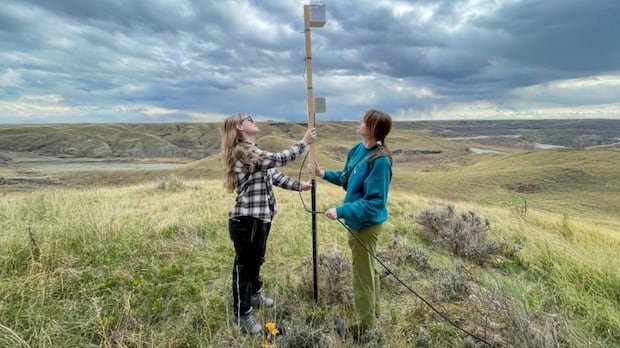

A duo of postgraduate scholars at the University of Windsor is actively monitoring the nighttime migration of birds by establishing an innovative research network spanning Canada. Natalie Emerick and Madison Bygrove have recently returned to their laboratory in southwestern Ontario after deploying 100 acoustic recorders in locations ranging from Vancouver Island to Newfoundland.
These recorders, contained within 3D-printed boxes, are equipped with microphones that capture bird calls emanating from the night sky. The collected sounds are processed and classified by AI technology, with the data and species identifications accessible through an open-source dashboard utilizing Motus Audio technology.
Birds engage in nighttime communication through vocalizations or the sounds of their flight to navigate and travel together in darkness, presenting a challenging task for observation and identification until now. Emerick highlighted that their research is pioneering in the eastern regions, with volunteers across various locations contributing to the comprehensive monitoring of bird migrations.
The advancement of tracking and recording technologies has enabled the researchers to effectively handle vast amounts of data. Bygrove emphasized the critical role of software in streamlining data analysis, significantly reducing the time required to process the extensive nightly data recordings.
The duo leveraged existing Canadian migration monitoring networks to identify strategic recorder placement locations, engaging both professional ornithologists and general enthusiasts in hosting the devices. Their investigation also delves into the impact of artificial nighttime illumination on bird behavior and communication patterns.
As the fall migration season approaches, Emerick and Bygrove aim to derive concrete insights from the collected data, continuously refining their algorithms for enhanced species identification accuracy. The research initiative, supported by Motus Audio technology, is creating an “audio curtain” across Canada, shedding light on previously inaccessible aspects of avian migration dynamics.
Ecologist Ryan Norris, collaborating on the project, underlined the significance of the research in tracking birds through the Canadian boreal forest, where traditional monitoring methods face challenges. The utilization of AI models has proven effective in identifying diverse bird species, aiding in the comprehensive understanding of migration patterns and potential conservation implications.
Norris expressed enthusiasm for the project’s potential to unravel the intricacies of bird migration across seasons, offering valuable insights into population dynamics and conservation strategies. The initiative stands as a pioneering effort in avian research, contributing to the collective knowledge of bird movements and ecological interactions.
[End of Rewritten Article]