
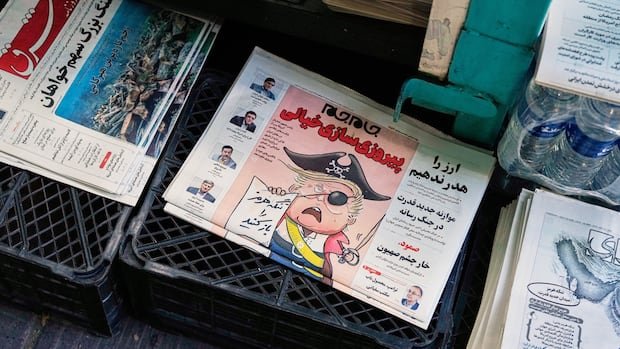

Iran has communicated its response to the latest U.S. ceasefire proposal through Pakistani intermediaries, emphasizing the desire for negotiations to focus on ending the war permanently. However, U.S. President Donald Trump promptly dismissed the proposal as “TOTALLY UNACCEPTABLE!” without elaborating. Iran aims to cease hostilities on all fronts, including in Lebanon, where Israel is engaged in conflict with the Iranian-backed Hezbollah group, and to ensure shipping security, as reported by state TV. The recent U.S. proposal addressed terms for ending the war, reopening the Strait of Hormuz, and scaling back Iran’s nuclear activities.
President Trump, via social media, accused Tehran of engaging in gamesmanship with the U.S. for almost five decades, asserting that they will no longer be tolerated. The U.S. Ambassador to the United Nations, Mike Waltz, mentioned on ABC News that diplomacy is being given every opportunity before resorting to hostilities. Iran’s new supreme leader, Mojtaba Khamenei, who has not been publicly visible since the war commenced on February 28, reportedly issued resolute directives for continued operations and robust confrontation with adversaries while meeting the joint military command head, as per state media.
The fragile ceasefire, commencing on April 8 and later extended by Trump, faced a test when a drone caused a minor fire on a ship off Qatar. Additionally, the United Arab Emirates and Kuwait reported drone intrusions into their airspace, with the U.A.E. claiming to have downed two drones and attributing the incident to Iran. No casualties were reported, and no entity immediately claimed responsibility. Following the attack on the ship, Qatar’s Foreign Affairs Ministry labeled it a dangerous escalation imperiling maritime trade routes and essential supplies in the region. The United Kingdom Maritime Trade Operations Centre did not disclose details regarding the ship’s ownership or origin.
Kuwait’s Defence Ministry spokesperson, Brig.-Gen. Saud Abdulaziz Al Otaibi, mentioned the forces’ response to the drones without specifying their origin. Drones have been utilized by Iran and its allied groups, such as Hezbollah in Lebanon, for numerous strikes since the onset of the conflict triggered by U.S. and Israeli actions against Iran.
President Trump has reiterated threats of resuming full-scale bombings unless Iran agrees to terms regarding the Strait of Hormuz and its nuclear program. Iran has obstructed the vital waterway crucial for global oil, natural gas, and fertilizer transportation, impacting global markets. The U.S. military has enforced a blockade on Iranian ports since April 13, redirecting 61 commercial vessels and disabling four. Recently, it engaged two Iranian oil tankers attempting to breach the blockade. Iran’s Revolutionary Guard navy warned of a severe response to any attack on Iranian vessels or commercial ships, including striking U.S. bases and enemy ships.
One contentious issue in negotiations pertains to Iran’s highly enriched uranium. The United Nations nuclear agency reported Iran possessing over 440 kilograms of uranium enriched up to 60 percent purity, a technical step away from weapons-grade material.
Iranian military forces affirmed their readiness to safeguard uranium storage sites, expressing concerns about potential infiltration or heli-borne operations to seize the material. Israeli Prime Minister Benjamin Netanyahu underscored the necessity of removing enriched uranium from Iran to fully conclude the conflict, citing Trump’s intent to physically achieve this goal.
Russian President Vladimir Putin reiterated Moscow’s proposal to remove enriched uranium from Iran to facilitate negotiation efforts. Most of Iran’s highly enriched uranium likely resides at the Isfahan nuclear complex, which faced airstrikes last year and lesser attacks this year.
Iran’s deputy foreign minister cautioned against an anticipated French-British initiative to bolster maritime security in the Strait of Hormuz post-conflict. The official warned of immediate and decisive responses from armed forces to any foreign vessels cooperating with illegal U.S. actions violating international law. French President Emmanuel Macron clarified that the mission would focus on securing shipping, not military deployment, once conditions permit.
Recent attacks on vessels in the Persian Gulf prompted the U.S. to pause efforts to guide ships through the strait. South Korea reported an investigation indicating that two unidentified objects struck a South Korean-operated vessel, causing an explosion and fire, though the responsible party remains undetermined.