
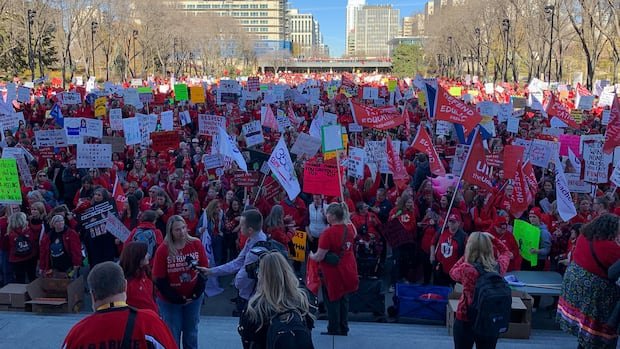

Some Alberta school divisions and a labor expert are expecting a bill to be introduced on Monday that will mandate teachers to return to work and specify the resumption of classes. Mount Royal University’s human resources professor, Christian Cook, mentioned that once the back-to-work legislation is enacted, teachers could be required to return to schools within 24 to 48 hours, making any strike action illegal.
The Alberta government announced that Finance Minister Nate Horner will present the Back to School Act on Monday with the aim of ending the lockout of 51,000 public, Catholic, and francophone teachers who initiated a strike on October 6. While the four major school divisions in the province are uncertain about the exact resumption date, they are advising families not to send their children to school on Monday until the legislative process is completed.
Edmonton Catholic Schools anticipates that the legislation will outline the timeline for teachers to resume work, as stated by spokesperson Christine Meadows. The government house leader’s office did not provide details about the timing of tabling Bill 2 or the commencement of debates in the legislature on Monday.
Moving towards fast-tracking the process, the government has proposed five motions in the order paper to expedite the bill’s passage through multiple stages in a single day. Despite opposition from the NDP, the United Conservative Party government is likely to secure majority approval for the legislation.
If the bill is fast-tracked successfully, it could pass by Tuesday, Cook mentioned, emphasizing the potential penalties for non-compliance by teachers or their association once the law is in effect. However, the legislation, if approved, will not address the fundamental issues that led to the strike, according to Alberta Teachers’ Association (ATA) president Jason Schilling.
The ATA is advocating for measures to address rising inflation, improve working conditions, and enhance support for students with complex needs. Schilling highlighted the absence of a legal framework in Alberta to regulate student-teacher ratios and class sizes, which is a concern for the teaching community.
Premier Danielle Smith suggested alternative solutions to address classroom challenges, emphasizing the potential recruitment of more educational assistants. The government may opt for negotiation, mediation, or binding arbitration to resolve the dispute, with arbitration potentially limiting the scope of discussions.
Despite criticisms regarding workers’ collective bargaining rights, the government’s use of back-to-work legislation is poised to proceed, impacting all public sector labor unions in the province. Concerns about the broader implications on democracy have been raised by various groups monitoring the situation.
School boards in Edmonton and Calgary are preparing for the return of teachers and students, although specifics on making up lost instructional time remain unclear. Discussions are ongoing regarding potential adjustments to the school calendar to accommodate missed days and ensure a smooth transition back to in-person learning.
Parents have expressed mixed feelings about the impending return to school, with some highlighting concerns about unresolved issues such as overcrowded classrooms and inadequate support for teachers. The complex situation surrounding the education system in Alberta continues to draw attention and spark conversations about the future of schooling in the province.