
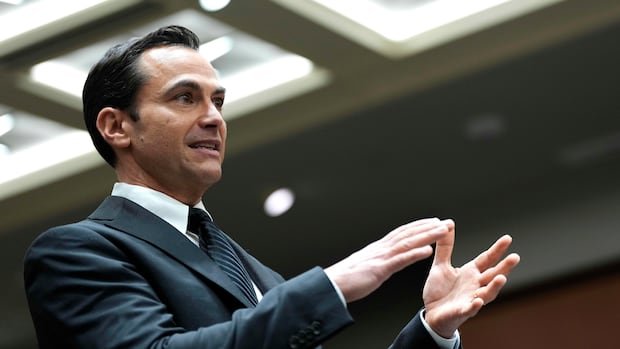

During his brief stint as the interim parliamentary budget officer in Canada, Jason Jacques faced allegations of bias, critique for his communication style, and eventually, commendation for representing an institution that now ranks as the top among its global counterparts.
Handpicked by Prime Minister Mark Carney in September to fill the position until a permanent parliamentary budget officer could be selected, Jacques was determined to make a significant impact during his six-month tenure. He kickstarted his term by requesting the Organization for Economic Co-operation and Development (OECD) to conduct the first-ever evaluation of Canada’s Office of the Parliamentary Budget Officer to assess its performance compared to similar bodies in other nations. This assessment focused on the office itself, which provides impartial financial analysis to Parliament, rather than individual officers.
Expressing his rationale, Jacques mentioned to a parliamentary committee last week, “After nearly 20 years, I believed that an external review of the office was long overdue. I specifically urged them to outline a path for sustaining our institution as one of the top performers among OECD countries.”
The recent evaluation by the OECD, released last week, positioned the PBO at the top among the 35 countries scrutinized. Following Canada was the U.S. Congressional Budget Office in second place and the Bureau for Economic Analysis in the Netherlands in third.
Acknowledging this achievement during Jacques’s final appearance as interim PBO before a parliamentary committee, Conservative MP and committee chair Kelly McCauley praised the institution’s recognition by the OECD. However, alongside the top ranking, the OECD report also highlighted five key areas for enhancement, such as leadership appointments, data acquisition, and ensuring analysis quality.
The OECD advised the PBO to enhance its prioritization of work and improve communication of analysis and reports to parliamentarians and the public. Criticism regarding the PBO’s communication methods was illustrated with two instances: an error in carbon price calculations and Jacques’s controversial remarks on Canada’s fiscal condition. The report urged for clearer internal communication guidelines to prevent misunderstandings.
Noteworthy was the OECD’s recommendation for the PBO to establish a peer-review panel to formalize the process, enhancing transparency in its operations. Additionally, the report suggested legislative changes to enable direct access to tax data from the Canada Revenue Agency, streamlining processes and enhancing efficiency.
As Jacques concluded his term, he emphasized the necessity for improvements in appointing interim PBOs to avoid perceptions of bias. He advocated for a hiring process that upholds the PBO’s independence and professionalism. Jacques and the OECD concurred on the importance of distinguishing the PBO as an institution rather than focusing solely on the individual officer.
Looking ahead, Jacques remarked that transitioning the focus from the parliamentary budget officer to the office itself, akin to the U.S. Congressional Budget Office, would be beneficial. The future permanent PBO will need to consider these perspectives as they take the helm, following Jacques’s departure with no successor named yet.